



Medically reviewed by Dr. Levent Acar, MD
Founder & Lead Hair Transplant Surgeon
Updated on: November 04, 2026
The most common hair transplant side effects are swelling, scabbing, itching, and temporary shedding of the transplanted hair. They are part of normal healing and pass within days to weeks. Serious risks, such as infection, visible scarring or a failed result, are rare at an experienced clinic: at Cosmedica, an average of 98% of implanted grafts survive. The risk rises mainly at low-cost clinics where the team is less trained and less supervised by a doctor.
This guide explains which side effects are normal, which complications to watch for, what to do if a hair transplant goes wrong, and how to choose a safe clinic in Turkey.
Hair transplant side effects and risks at a glance
| At a glance | Figure |
|---|---|
| Graft survival rate at Cosmedica | 98% on average |
| Success rate of an FUE and DHI hair transplant | 95–98% |
| Counts as successful | ≥ 80% of transplanted grafts grow |
| Failure rate, low-quality clinics | Up to about 30% |
| Infection | Under 1% |
| Swelling | 3–4 days |
| Scabs fall off | After 7–10 days |
| Normal shedding of transplanted hair | 2–4 weeks after surgery |
| New growth starts | About 3–4 months after surgery |
| Final result | About 12 months after surgery |
Figures: Cosmedica clinical experience and Kerure & Patwardhan, 2018.
Common side effects of a hair transplant
The common side effects of a hair transplant are the scalp’s normal reaction to the procedure. They need no treatment if you follow your aftercare instructions, and most are gone within two weeks.

| Time after surgery | What is normal |
|---|---|
| Days 1–4 | Swelling, tension and numbness in the scalp |
| Days 7–10 | Scabs in the donor and recipient areas fall off |
| Weeks 1–2 | Itching while the skin heals |
| Weeks 2–4 | Transplanted hairs shed (shock loss) |
| Months 3–4 | New hair starts to grow |
| Months 6–9 | The result becomes clearly visible |
| Month 12 | Final result |
- Swelling comes from the local anaesthetic and wound fluid. It can move down to the forehead and eyes and usually lasts 3–4 days. Sleeping with your head raised helps.
- Scabs and crusts form around each graft and fall off after 7–10 days. Do not pick at them.
- Itching is a sign of healing and lasts 1–2 weeks. Do not scratch, because this can damage fresh grafts.
- Numbness in the donor and recipient areas usually fades within a few days to weeks.
- Shock loss means the transplanted hairs fall out after 2–4 weeks. The follicles stay in place, and new hair grows from about the fourth month.
Results usually show after 6–9 months and can take up to 12 months (American Academy of Dermatology). Contact your clinic straight away if you notice discharge, a fever, or pain and swelling that get worse.
Hair transplant risks and complications
Serious complications after a hair transplant are rare, and most of them can be prevented by choosing an experienced team and following aftercare.
| Complication | How common | How to lower the risk |
|---|---|---|
| Poor growth or failed transplant | Rare at experienced clinics (at Cosmedica, 98% of grafts survive on average) | Experienced surgeon, strict aftercare |
| Unnatural hairline or wrong growth direction | Mostly linked to inexperienced teams | Check results for your hair type and technique |
| Over-harvesting of the donor area | Uncommon; leaves thin or bald patches at the back of the head | Donor assessment and a realistic graft number |
| Infection | Rare under sterile conditions | Take prescribed antibiotics, wash as instructed |
| Folliculitis (inflamed follicles) | Uncommon, treatable with antibiotics or topical medication | Do not scratch; contact the clinic early |
| Visible scarring | More likely with FUT (strip method) than FUE or DHI; small white dots with poor technique | FUE or DHI with the correct punch size |
| Dermal cysts | Rare and harmless, often gone within weeks | Contact the clinic if they last |
FUT vs. FUE and DHI: which technique carries more risk?

FUT carries the highest risk of visible scarring and infection. A strip of scalp is cut from the back of the head, which leaves a linear scar and a larger wound to heal. If the wound is not closed well, the scar can bulge. FUE and DHI take grafts one by one, so the wounds are tiny and heal within days.
With FUE and DHI, the main risk shifts from the wound to the skill of the team. Each graft must be placed at the right angle and in the natural growth direction, or the result looks unnatural. Cosmedica only uses Sapphire FUE and Micro Sapphire DHI.
| FUT | FUE / DHI | |
|---|---|---|
| Donor wound | Strip, linear scar | Tiny round punctures (0.85–0.95 mm) |
| Infection risk | Higher (larger wound) | Low |
| Visible scarring | Linear scar possible | Small white dots only with poor technique |
| Main skill risk | Wound closure | Graft placement and direction |
Who is not a good candidate for a hair transplant?
Patients at Norwood 7 with a thin donor area are usually not candidates. Certain blood-borne illnesses can also rule out surgery. Some very bald patients still get good results, so the decision should come from an examination of your donor area, not from your Norwood stage alone. See the donor area guide.
Long-term side effects of a hair transplant
Long-term side effects are rare. Most effects of a hair transplant are temporary and resolve within weeks. When something lasts, it is usually linked to the surgeon’s skill and the technique used.
- Scarring: a linear scar after FUT, or small white dots after FUE with the wrong punch size or poor technique.
- Numbness or sensitivity in the scalp can last several months and, rarely, stay permanently (StatPearls).
- Uneven growth or density, usually from poor graft placement.
- Thinning donor area after over-harvesting.
- Ongoing hair loss around the transplanted area. The transplanted hair is permanent, but native hair can keep thinning, so a medical treatment plan may be needed.
Hair transplant in Turkey gone wrong: signs and what to do
A hair transplant has gone wrong when much of the transplanted hair does not grow, the density is uneven, or the hairline looks unnatural. A transplant counts as a complete failure when more than 30% of the grafts do not survive. Do not judge too early: shedding at 2–4 weeks is normal, and the final result shows at about 12 months.
Signs of a failed hair transplant
- Thin coverage, or patches where transplanted hair never grows
- A grass-like or pluggy look
- Grafts growing in the wrong direction or at an unnatural angle
- A visible scar or a thinned-out donor area
Why hair transplants fail
- Experience of the team. Skill varies by technique. A team that is good at standard FUE may have less experience with DHI or afro hair.
- Wrong washing, missed medication or friction on the scalp can damage fresh grafts. According to Dr. Acar, most failures come from aftercare, not from the surgery itself.
- Graft rejection. This is rare. The usual cause is lichen planopilaris, an inflammation of the upper hair follicle.
- A weak donor area. The result depends on how much good donor hair you have.
How to fix a bad hair transplant
If a hair transplant in Turkey or elsewhere has gone wrong, contact the clinic first: infection, inflammation and slow growth can usually be treated. If grafts did not grow, a repair transplant with an experienced surgeon such as Dr. Levent Acar is often possible. It can fill thin areas, correct the hairline and cover scars. The ISHRS explains how earlier transplants can be revised and corrected. If you are not eligible, PRP or low-level laser therapy may help, and scalp micropigmentation can hide thin areas.
Is a hair transplant in Turkey safe?
Yes, a hair transplant in Turkey is safe if you choose a licensed clinic with an experienced team supervised by a doctor. Hair transplant clinics in Turkey must be licensed by the Turkish Ministry of Health, and the procedure must take place under the responsibility of a licensed doctor. Clinics that treat international patients also need a health tourism authorisation certificate, issued through USHAŞ. Accreditation by Joint Commission International (JCI) is voluntary and goes further.
Turkey is one of the world’s largest destinations for medical treatment: 1,506,442 international patients came for treatment in 2024, according to the official USHAŞ health tourism data. The UK Foreign Office advises patients to discuss treatment abroad with their own doctor first (GOV.UK travel advice).
| What to check | Where to check it |
|---|---|
| Ministry of Health authorisation | Ministry list of authorised health tourism facilities |
| Health tourism authorisation certificate | USHAŞ |
| Facility and doctors verified by the Ministry | HealthTürkiye |
| International accreditation (optional) | Joint Commission International |
| Who operates, and how many patients per day | Ask the clinic in writing before you book |
6 red flags of a risky hair transplant clinic in Turkey
| Red flag | What a good clinic does |
|---|---|
| You cannot find out who will perform the procedure or which doctor is responsible, or the surgery is left to unqualified staff (ISHRS) | Introduces the responsible doctor and the team who will treat you |
| Many patients are operated on the same day | Limits the number of operations per surgeon per day |
| A very high graft number is promised before anyone has examined you | Assesses your donor area first and gives a realistic graft range |
| The price is far below the market, or includes "unlimited grafts" | Gives a clear price based on your treatment plan |
| No Ministry of Health licence or health tourism certificate | Shows its licence and certificate on request |
| No aftercare once you are home | Gives you an aftercare plan and stays in contact after you return home |
Your hair transplant safety checklist
Before surgery
After surgery
Can a hair transplant cause cancer?
No. Cancer is not one of the side effects of a hair transplant: there is no scientific evidence that FUE, DHI or FUT causes cancer. The procedure only moves existing follicles in the upper layers of the skin. It does not change the genetic material of cells, which is what cancer requires.
Can you get a hair transplant after cancer?
Often yes. A past skin cancer or other cancer does not automatically rule out surgery. It depends on the type of cancer, the stage, the treatment and whether there are signs of recurrence.
- Get clearance from your oncologist first, and ask whether a waiting period after treatment is needed.
- Have the surgeon check your donor hair and any scars from earlier surgery or radiation.
- Keep your regular check-ups with your oncologist and dermatologist after the transplant.
Hair transplant holes and trypophobia
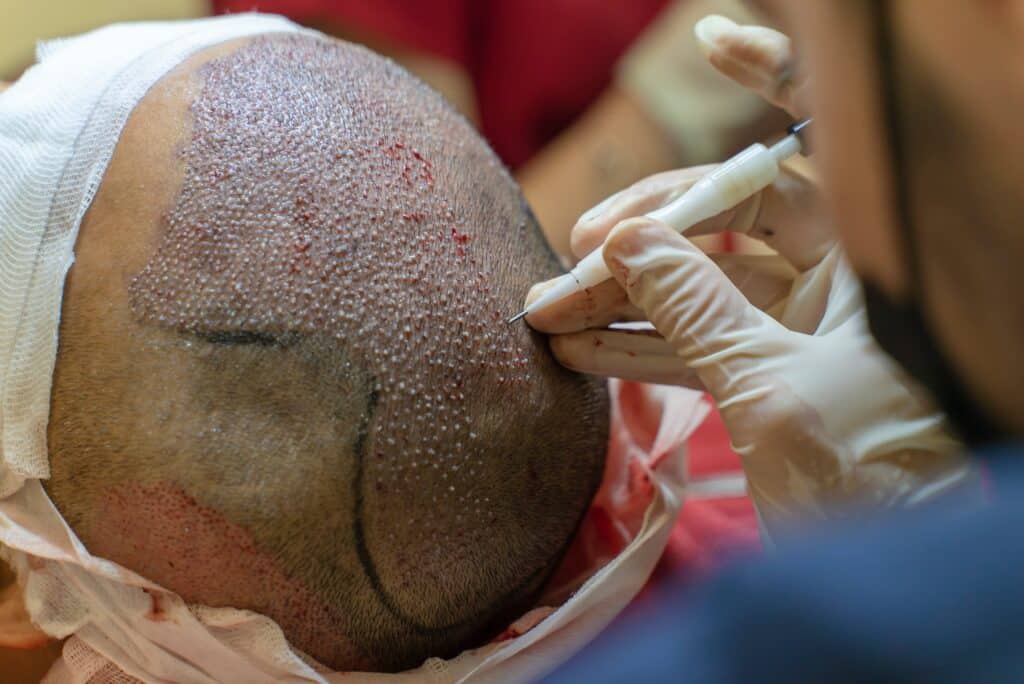
After FUE, the donor area shows many small dots. They are 0.85–0.95 mm wide and are most visible on a shaved head. During healing the scalp looks grazed, with slight red scabs, and the holes close within a few days. Final results do not show visible marks.
For people with trypophobia, a strong aversion to clusters of small holes, these first days can be distressing. Trypophobia does not rule out a transplant. What can help:
- Keep the bandage on the back and sides of the head longer, so you see less of the donor area.
- Look at healed before-and-after photos to see the end result.
- Use breathing exercises or meditation to lower anxiety.
- For strong symptoms, exposure therapy or CBT with a therapist can help. If anxiety is linked to a mood disorder, a doctor may prescribe medication.
Hair transplant Risks : Frequently Asked Questions
Is it safe to get a hair transplant in Turkey?
Yes, if you choose a licensed clinic with an experienced team supervised by a doctor. Turkey is one of the largest hair transplant destinations, and its clinics range from accredited medical centers to low-cost operators with less training and oversight.. Most of the risk sits with the second group.What are the risks of getting a hair transplant in Turkey?
The risks are the same as anywhere: a poor or failed result, an unnatural hairline, over-harvesting of the donor area, infection and visible scarring. They rise at low-cost clinics that treat many patients a day or work without proper medical supervision. At an experienced clinic, failure is rare: at Cosmedica, 98% of grafts survive on average.What happens if my hair transplant in Turkey goes wrong?
Contact your clinic first: infection, inflammation and slow growth can usually be treated. Wait about 12 months before judging the final result. If grafts did not grow, a repair transplant by an experienced surgeon is often possible. Otherwise PRP, laser therapy or scalp micropigmentation can improve the look.Are hair transplant clinics in Turkey regulated?
Yes. Clinics must be licensed by the Turkish Ministry of Health, and the transplant must take place under a doctor’s responsibility. Clinics that treat foreign patients also need a health tourism authorisation certificate. Ask for the licence and the name of the doctor who will operate on you.What are the side effects of getting a hair transplant in Turkey?
The usual side effects are swelling for 3–4 days, scabbing for 7–10 days, itching for 1–2 weeks and shedding of the transplanted hair after 2–4 weeks. They are part of normal healing and do not depend on the country. Infection is rare under sterile conditions.Sources
- Hair Transplantation – StatPearls, NCBI Bookshelf
- Hair transplant – American Academy of Dermatology
- Black market and unlicensed technicians – ISHRS
- Hair revision and correction – ISHRS
- Health tourism data 2019–2024 – USHAŞ
- Authorised health tourism facilities – Republic of Türkiye Ministry of Health
- Health tourism authorisation – USHAŞ
- HealthTürkiye – Republic of Türkiye Ministry of Health
- Turkey travel advice: health – GOV.UK (FCDO)
- Joint Commission International