



Medically reviewed by Dr. Levent Acar, MD
Founder & Lead Hair Transplant Surgeon
Updated on: September 01, 2026
Most scales save the dramatic part for the end. The Norwood scale is no different. Norwood 7 sits right at the bottom of the chart, the most advanced point at which male pattern baldness reaches. By this stage, the top of the head is bald. Only a thin band of hair is left around the sides and back. It is the stage at which a lot of men quietly worry about the first time they notice a receding hairline.
This article goes through what the final stage looks like, how long it takes to get there, and what can actually be done about it.
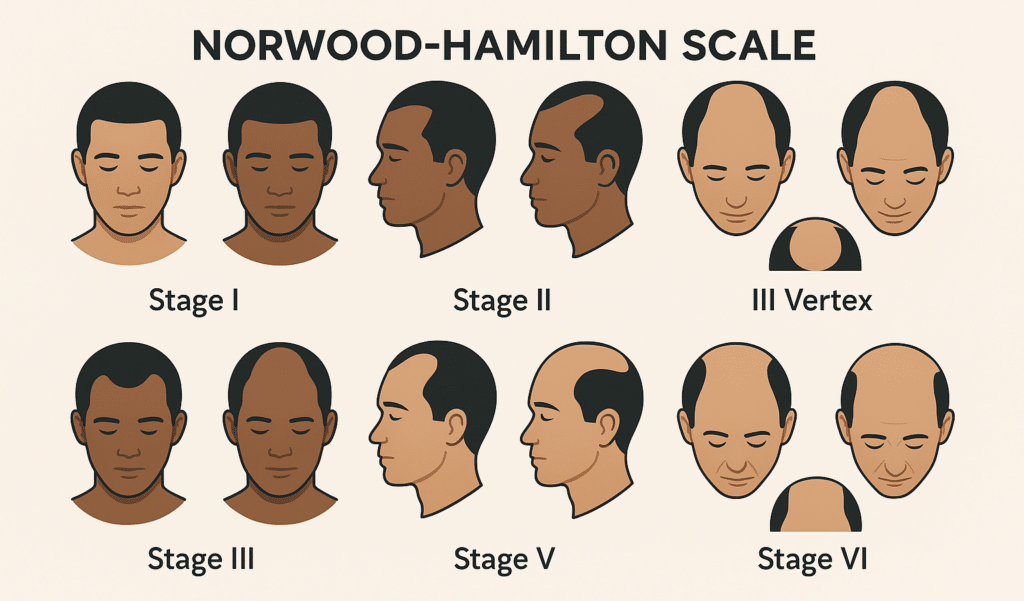
What Is the Norwood Scale?
The Norwood scale, sometimes called the Hamilton-Norwood scale, is the standard system doctors use to classify the stages of male pattern baldness. It runs from stage 1, a full head of hair, to stage 7, the most advanced stage of hair loss. Each Norwood stage marks a recognizable pattern of recession and thinning.
Why does it matter? Because it gives everyone a shared language. When a surgeon and a patient both refer to a Norwood stage, they are talking about the same thing. It also helps set realistic expectations before any treatment starts.
What Does a Norwood 7 Hairline Look Like?
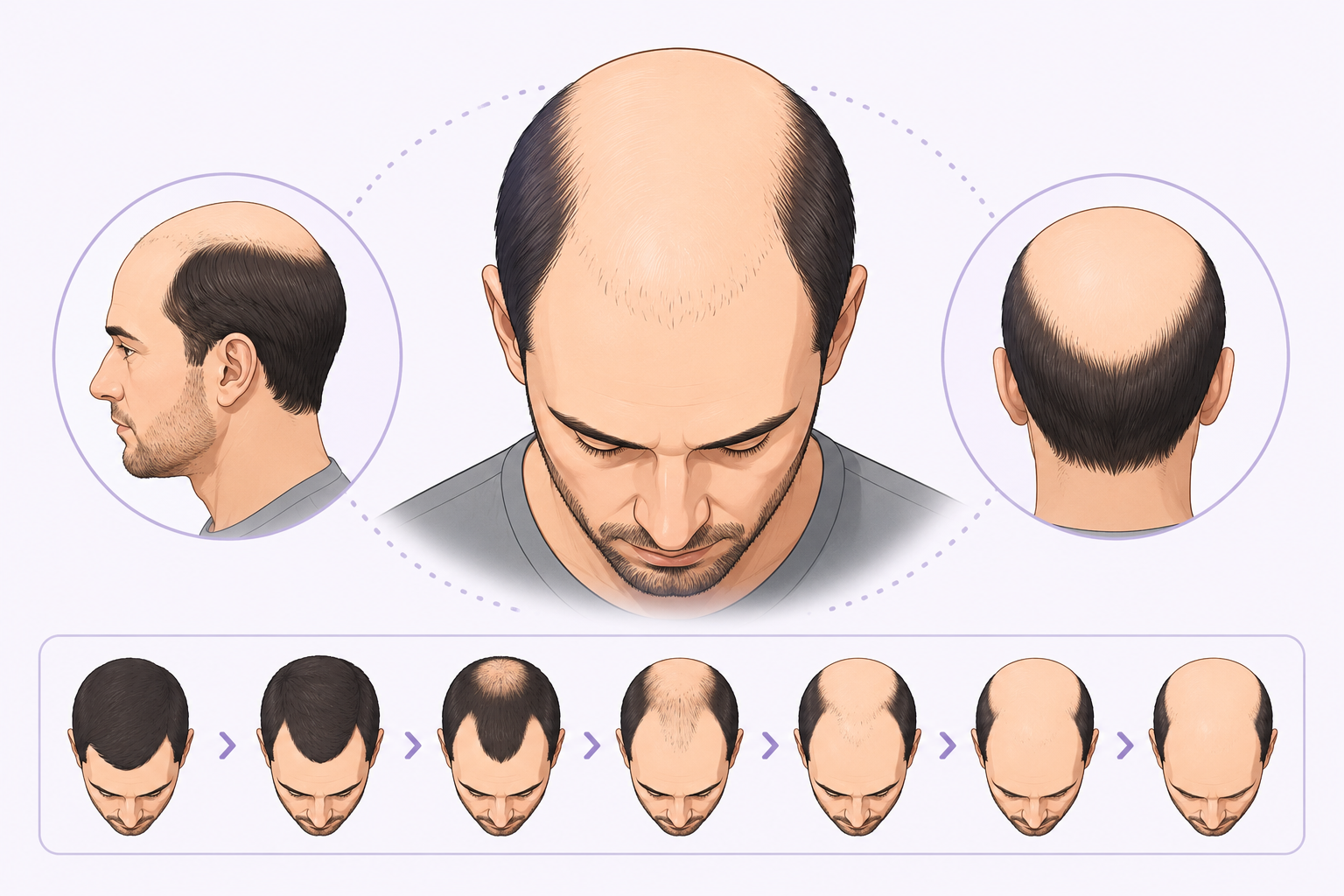
It is the most distinctive stage on the chart. The defining feature is a horseshoe-shaped band of hair that remains around the sides and back of the head, with the whole top bald.
At this point, the hair loss covers three zones at once:
- The frontal hairline has receded completely
- The mid-scalp is bare
- The crown, or vertex, has joined the bald area
What is left is the donor zone. That is the strip of hair at the back and sides that tends to resist male pattern baldness. This horseshoe pattern is the hallmark of the stage and the reason it is easy to spot. The hair remaining in the frontal area is minimal. The crown is almost completely bald, with only a few follicles left.
How Long Does It Take to Progress from Norwood 6 to Norwood 7?
There is no fixed timetable. Male pattern baldness is driven by genetics and the hormone DHT. The pace varies a lot from one person to the next.
A few general points hold true:
- Progression from one stage to the next can take several years
- Men who start losing hair young often progress further over a lifetime
- The jump from Norwood 6 to stage 7 involves the crown and the remaining mid-scalp hair thinning away
The difference between the two final stages is mostly about how much hair remains on top. Norwood 6 still has some separation between the front and the crown bald areas.
Stage 7 is when that bridge disappears, and the whole top is bare. Medications like finasteride or minoxidil can slow things down for some men. It does not reverse the loss that has already occurred.
How Many Grafts Are Needed for Norwood 7 Hair Loss?
This is where the final stage gets complicated. The bald area is large. The donor supply is limited. So, that tension shapes everything about treatment here.
Estimates from clinics and surgeons vary, but the broad ranges line up:
- A minimum of around 7,000 grafts would be needed for full coverage of a stage 7 scalp.
- Some surgeons estimate that a Norwood 7 scalp could require 9,000 to 10,000 follicular units for complete coverage, while the average lifetime scalp donor supply is only 6,000 to 8,000 grafts.
- Extracting more than 6,000 grafts in a single day is considered medically unsafe, so a two-session approach is standard at this stage.
So the donor area usually cannot supply enough hair for full density. Surgeons actually plan around that. Beard and chest hair are sometimes used as extra donor sources. Beard hair can add 1,000 to 2,000 grafts and is valued for its thickness. Chest hair can add another 500-1,000. The number of grafts that can be safely harvested is the single biggest factor in determining the result.
How to Treat Hair Loss at Norwood Stage 7?
Treatment here is about strategy, not full restoration. Donor hair is finite. So the goal shifts from recreating a teenage hairline to achieving the greatest visual impact from the hair available.
A typical plan at this stage includes:
- A conservative, slightly higher hairline to frame the face
- Priority given to the front and mid-scalp over the crown
- Grafts spaced to create the appearance of coverage across a wide area
The principle most surgeons follow is simple. Preserve the donor zone. Overharvesting is one of the most critical mistakes, because once the donor area is depleted, no further surgical options remain. For anyone weighing up a hair transplant in Turkey, a full donor assessment is the essential first step before anything is planned.
What Hair Transplant Method Is Used for Advanced Loss?
The technique matters more here because every graft counts. There are two main methods of hair harvesting: FUT and FUE. The FUT method removes a strip of skin and is less and less used. The FUE method extracts each follicular unit individually using a micro-punch.
At Cosmedica Clinic in Istanbul, only FUE and its refinement, the Micro Sapphire DHI method, are used. The Micro Sapphire DHI approach is a three-step process:
- Hair roots are extracted using FUE
- Channels are opened with a microsapphire blade rather than a metal one, which makes smaller incisions
- Roots are implanted using a DHI implanter pen that holds each graft in a protected shield
The implanter pen allows the surgeon to remove and reinsert grafts in a single step. That helps protect the roots during transfer. The method is linked to faster healing and stronger growth rates. For a closer look, the Micro Sapphire DHI method page explains each step.

What Are Realistic Norwood 7 Hair Transplant Results?
Expectations matter here more than at any other stage. A hair transplant at this stage can produce a clear, visible improvement. But it works within the limit of the hair remaining in the donor zone.
Realistic outcomes usually involve:
- A restored frontal hairline that frames the face
- Better coverage across the mid-scalp
- Partial rather than full crown coverage in most cases
- Lower overall density than a less advanced stage would allow
The strongest results here come from honest planning. A higher hairline and smart graft placement often look more natural than trying to thinly cover everything. Photos taken twelve months after surgery give the clearest picture, since that is when the final growth shows. The hair transplant Turkey before and after gallery shows how results vary across different hair loss patterns.
Patients comparing options often look at the Turkey hair transplant cost alongside the expected graft count, too, since the two are closely tied at this stage.