



Medically reviewed by Dr. Levent Acar, MD
Founder & Lead Hair Transplant Surgeon
Updated on: July 23, 2026
What if the hair you lost years ago isn’t gone, but only sleeping?
PP405 is an investigational topical treatment developed by Pelage Pharmaceuticals that aims to reactivate dormant hair follicles rather than grow new ones. For decades, doctors assumed that once a follicle stopped producing hair, it was gone for good. New research suggests otherwise: many follicles may simply be inactive, or “sleeping,” rather than destroyed.
PP405 is designed to wake them back up and enter a growing field called regenerative medicine. In this article, we explain how PP405 works, what the Phase 2a trial data actually show, how it compares to existing treatments like minoxidil and finasteride, and whether it’s worth waiting for.
What is PP405?
PP405 is a topical small-molecule compound developed by Pelage Pharmaceuticals, currently in Phase 2a clinical trials (NCT06393452) for androgenetic alopecia (pattern hair loss), one of several causes of hair loss that patients experience. It is non-hormonal and designed to reactivate dormant hair follicle stem cells in both men and women.
Unlike existing treatments that primarily target hormonal causes of hair loss, PP405 acts directly on the biological pathway controlling the hair growth cycle itself, by working on stem cells that remain present even in areas of visible balding. Understanding this mechanism connects to broader questions about DHT and hair loss, since most current therapies target that hormonal pathway instead.
How does PP405 work?
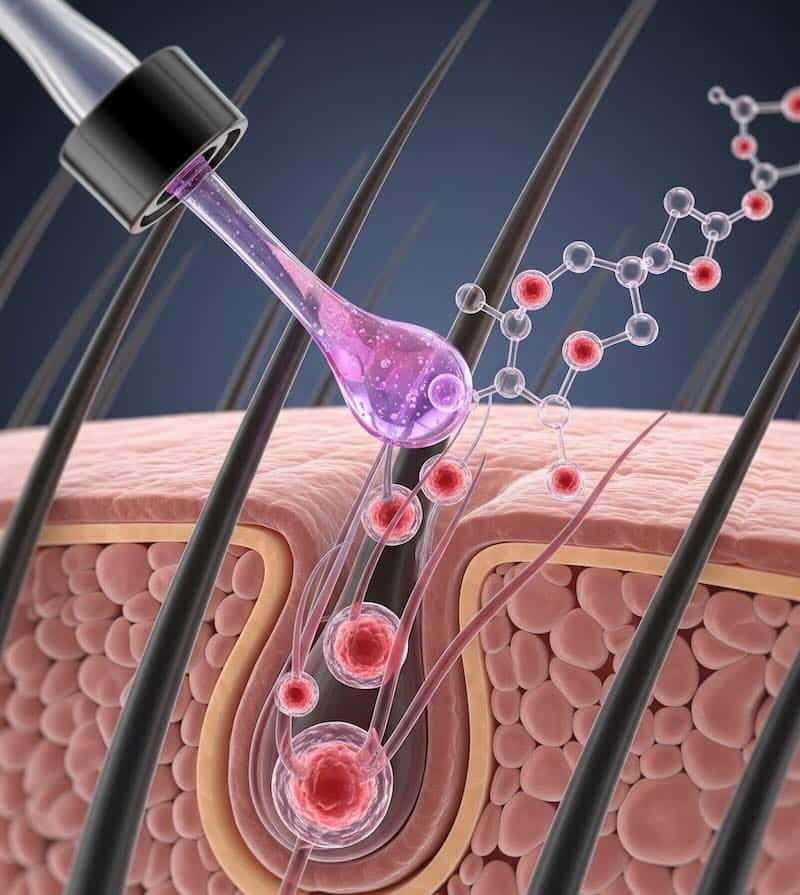
The biological cycle of hair involves phases: growth (anagen), regression (catagen), and rest (telogen). In androgenetic alopecia-
- The anagen phase shortens,
- Follicles miniaturise,
- Hair density declines, and the visible hair vanishes.
The new paradigm with PP405 is that many of those follicles are not dead, but asleep. The therapy targets the metabolic switch in stem cells that control whether a follicle is active or dormant. Here is a simplified breakdown of the mechanism:
- PP405 inhibits the mitochondrial pyruvate carrier, thereby shifting the cell’s metabolism from oxidative phosphorylation toward glycolysis and increasing LDH activity.
- Increased lactate and glycolytic flux signal the stem cells to divide and activate the follicle growth cycle.
- The result is entry into or prolongation of the anagen phase, thicker (“visible hair”) shafts, and improved hair density.
What are the key scientific features?
- PP405 inhibits the mitochondrial pyruvate carrier (MPC) in follicle cells.
- This shifts cell metabolism toward glycolysis and increases lactate dehydrogenase (LDH) activity, which appears to signal dormant stem cells to re-enter the active growth phase.
- The Phase 2a trial (NCT06393452) was a randomized, multicenter, double-blind, vehicle-controlled study involving 78 patients aged 18 to 55.
- Patients applied a 0.05% topical gel or placebo daily for 4 weeks, followed for up to 12 weeks.
Phase 2a Trial Snapshot
Trial Detail | Value |
|---|---|
Trial ID | NCT06393452 |
Phase | 2a |
Design | Randomized, multicenter, double-blind, vehicle-controlled |
Participants | 78 adults, aged 18-55 |
Dosing | 0.05% topical gel, daily for 4 weeks |
Follow-up | Up to 12 weeks |
Key result | 31% of men with advanced hair loss saw >20% density increase at 8 weeks vs. 0% placebo |
This mechanism places PP405 alongside other regenerative approaches such as Regenera Activa and exosome therapy, both of which work by stimulating the scalp’s existing biological potential rather than replacing follicles.
Dormant vs. dead hair follicles: why the distinction matters
Not all hair loss is equal. Some follicles are dormant, inactive but structurally intact, while others are permanently destroyed, often through scarring, prolonged miniaturization, or advanced androgenetic alopecia. Understanding which category applies to your hair loss is essential groundwork, and it should be determined by a proper diagnostic assessment, not guesswork.
PP405’s entire premise rests on this distinction: it can only work on follicles that are still alive but inactive. Where hair-forming units are gone, no topical or regenerative therapy, however promising, can restore them.
Factor | Dormant Follicle | Dead/Destroyed Follicle |
|---|---|---|
Structure | Intact but inactive | Intact but inactive |
Responds to PP405? | Potentially yes | No |
Responds to transplant? | N/A (not needed) | Yes, via donor relocation |
Typical cause | Early-stage androgenetic alopecia | Advanced androgenetic alopecia, scarring alopecia |
Why hair transplants still lead the way
If a region is bald because follicles are absent or destroyed, medical therapies alone will not restore hair-forming units. That is why surgical restoration, with a hair transplant in Turkey, remains the gold standard in some instances.
At Cosmedica Clinic in Istanbul, patients are offered modern techniques, including Micro Sapphire DHI, a refined form of FUE. The procedure involves the extraction of individual follicular units from the donor zone using a micro-punch, the creation of insertion canals with micro-sapphire blades for reduced trauma, and the implantation of follicles via a DHI pen, which protects grafts and enables precise angulation.
Such techniques also show how surgical and regenerative approaches can work side by side. Where innovative agents such as PP405 may reactivate dormant follicles, a transplant can restore areas where follicles are permanently lost, including consideration of your donor area capacity, which is finite and should be used strategically.
What did the Phase 2a trial actually find?
According to Drug Topics, Pelage Pharmaceuticals reported that 31% of men with more advanced hair loss saw a greater than 20% increase in hair density at 8 weeks, compared to 0% in the placebo group. The trial also found that PP405 induced new hair growth in some areas with no previously visible hair, suggesting a genuine regenerative effect rather than simply slowing loss.
Arash Mostaghimi, MD, MPH, FAAD, vice chair of Clinical Trials and Innovation at Brigham and Women’s Hospital, commented: “Despite affecting millions, hair loss has seen remarkably little progress in clinical research. What’s compelling about PP405 is that it brings scientific rigor to a space that’s needed it for decades.”
Christina Weng, MD, Chief Medical Officer of Pelage Pharmaceuticals, added: “These early clinical results reinforce the potential of our approach to go beyond slowing the hair loss process and directly drive hair follicle regeneration.”
PP405 was also well tolerated, with no systemic absorption detected in blood plasma, an early safety signal, though still limited to a small trial population.
Why hair transplants still lead the way
If a region is bald because follicles are absent or destroyed, medical therapies alone will not restore hair-forming units. That is why surgical restoration remains the gold standard in some instances.
At Cosmedica Clinic in Istanbul, patients are offered modern techniques, including Micro Sapphire DHI, a refined form of FUE. The Micro Sapphire DHI procedure involves:
- Extraction of individual follicular units from the donor zone using a micro-punch.
- Creation of insertion canals with micro-sapphire blades (smaller incisions, reduced trauma).
- Implantation of follicles via a DHI pen, which protects grafts and enables precise angulation.
These steps, taken together, represent why hair transplant Turkey continues to set international standards for modern restoration.
Such techniques also show how surgical and regenerative approaches can work side by side. Where innovative agents such as PP405 may re-activate dormant follicles, a transplant can restore areas where follicles are permanently lost.
To see visual examples of real-world outcomes, visit hair transplant Turkey before and after.
For detailed package and procedure information, you can also review Turkey hair transplant cost options provided by Cosmedica Clinic.
Should you wait for PP405?
Pelage Pharmaceuticals has stated it plans to begin Phase 3 trials in 2026, meaning any potential commercial availability is still likely years away. PP405 isn’t the only compound in this space. AMP-303 is another investigational therapy currently in development for hair regeneration, using a different mechanism. Both represent early-stage science, not established treatments.
For patients actively losing hair now, waiting carries a real cost: the donor area and remaining follicles don’t wait for clinical trials to conclude. This is why many patients pursue a diagnostic-first approach, understanding their Norwood scale stage and follicle status now, rather than delaying a call on treatment.
How does PP405 compare to existing treatments?
Treatment | Mechanism | Onset | FDA Status | Best For |
|---|---|---|---|---|
PP405 | Reactivates dormant follicle stem cells | Weeks (early data) | Phase 2a trial | Thinning areas with dormant follicles |
Minoxidil | Increases blood flow to follicles | 3-6 months | FDA-approved | General pattern hair loss maintenance |
Finasteride | Blocks DHT hormone conversion | 3-6 months | FDA-approved | Hormonal (androgenetic) hair loss |
Hair Transplant (FUE/DHI) | Surgically relocates living follicles | Immediate placement, growth in 8-12 months | Established surgical procedure | Areas with absent/destroyed follicles |
Dr. Levent Acar, founder of Cosmedica Clinic, notes that patients considering emerging therapies should first understand whether their hair loss is a candidate for regenerative approaches at all, or whether follicles are already beyond reactivation, something only a proper scalp assessment can determine.
Frequently Asked Questions
What is PP405 used for?
PP405 is an investigational topical treatment for androgenetic alopecia, currently in Phase 2a clinical trials (NCT06393452). It targets dormant hair follicle stem cells to reactivate natural hair growth, rather than addressing hormonal causes like existing treatments.
Is PP405 approved by the FDA?
No. PP405 is still in clinical trials and has not been approved for hair loss treatment. Pelage Pharmaceuticals has stated it plans to begin Phase 3 trials in 2026, meaning FDA approval, if it happens, is still years away.
Does PP405 regrow hair in completely bald areas?
Early trial data suggest PP405 induced new hair growth in some areas with no previously visible hair, but it’s designed to reactivate dormant follicles, not create new ones. It’s unlikely to help in areas where follicles have been fully lost or scarred.
How is PP405 different from minoxidil or finasteride?
Minoxidil and finasteride primarily address hormonal or circulatory factors and typically take 3 to 6 months to show results. PP405 targets the metabolic pathway controlling follicle stem cell activity directly, with early trial data showing measurable biological activity within weeks, though long-term comparative data doesn’t yet exist.
Can PP405 replace a hair transplant?
No. PP405 targets dormant but structurally intact follicles. It cannot restore areas where follicles have been permanently lost or scarred. Those cases still require surgical hair restoration such as FUE or DHI.
When will PP405 be available?
Pelage Pharmaceuticals has stated it expects to begin Phase 3 trials in 2026. Commercial availability, if trials succeed, would likely follow several years after that.