



Medically reviewed by Dr. Levent Acar, MD
Founder & Lead Hair Transplant Surgeon
Updated on: September 01, 2026
If you’ve noticed your hair thinning or your hairline creeping back, you’re not alone. Male pattern hair loss affects millions of men worldwide, and one of the most useful tools for understanding where you stand is the Norwood Scale. It’s a widely used classification system that maps the progression of hair loss in men.
Whether you’re just starting to notice a slight recession or dealing with more significant hair loss, this scale can help you understand what’s happening and what you can do about it.
What is the Norwood Scale?
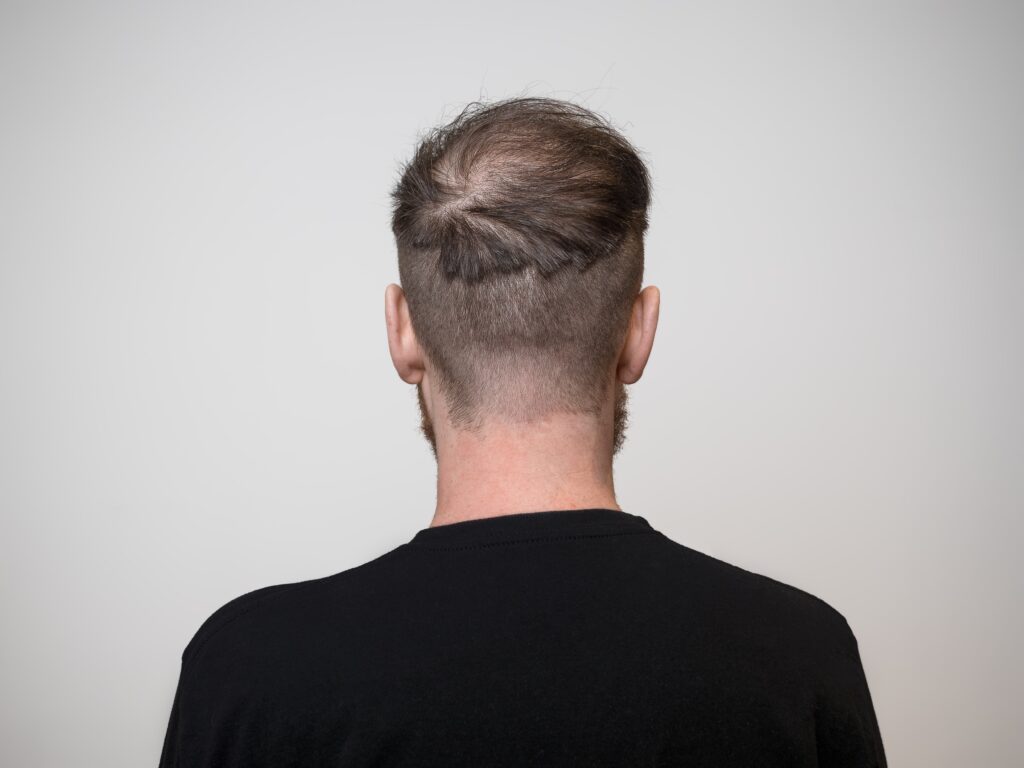
The Norwood Scale, also known as the Hamilton Norwood Scale, is a classification system used to stage male pattern baldness. The Norwood Scale was first developed by Dr. James Hamilton in the 1950s and later updated by Dr. O’Tar Norwood in the 1970s. Today, it is widely known as the Hamilton-Norwood scale.
The scale tracks the progression of hair loss by examining the frontal hairline, crown area, and the amount of hair remaining on the scalp. It helps doctors understand the specific pattern of hair loss and determine which treatment may work best.
What Are the Hair Loss Stages According to the Norwood Scale?
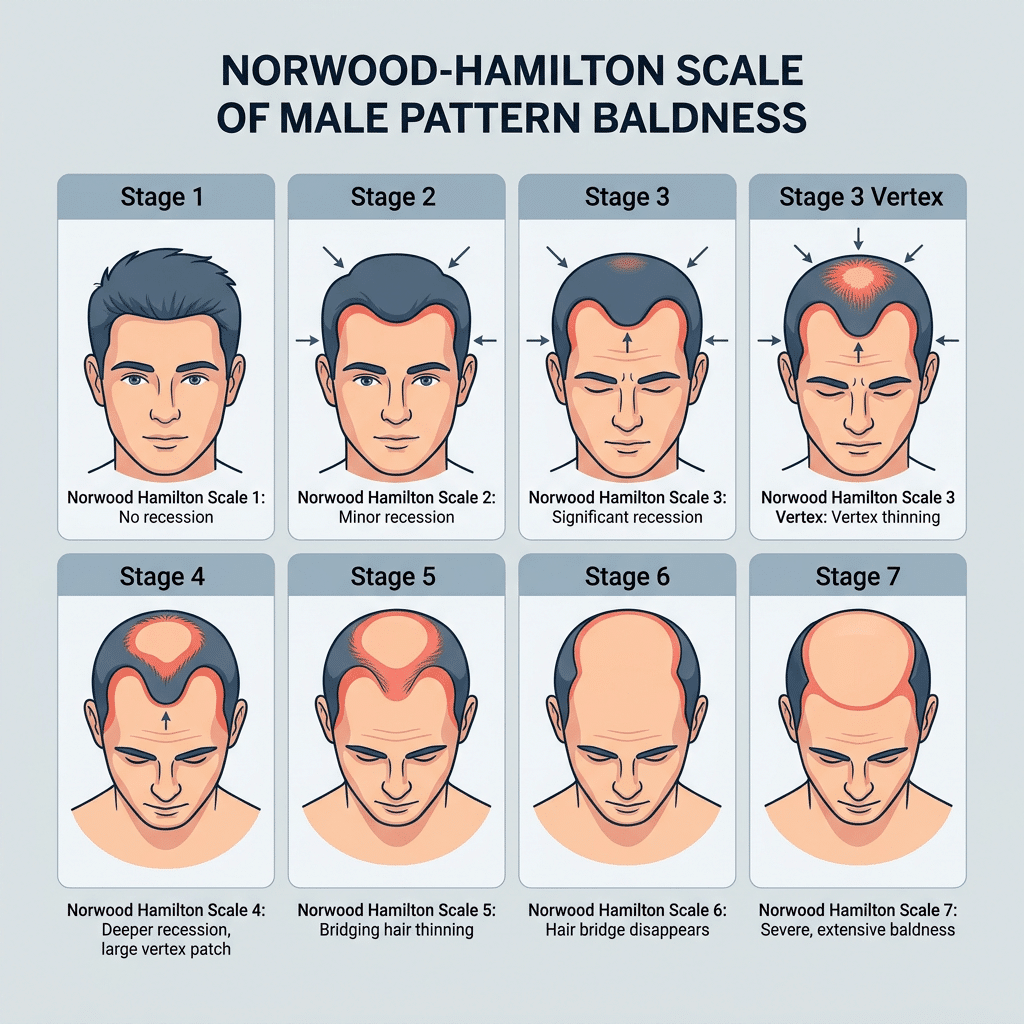
Here’s a quick breakdown of each stage, from minimal thinning all the way to advanced baldness:
Norwood 1: The Control Stage
At Norwood stage 1, there is no visible hair loss or recession. This is considered a full head of hair.
- Treatment: No surgery needed. If you have a family history of baldness, proactive medical support (Minoxidil) may be discussed to maintain density.
- Grafts Needed: 0
Norwood 2: The Mature Hairline
Norwood 2 results in a minor recession at the temples, often called a “mature hairline.” This is very common and doesn’t always lead to advanced balding.
- Treatment: PRP Therapy or Finasteride to stabilize the hairline. Doctors often advise against a transplant at this stage to save donor hair for the future.
- Grafts Needed: 500 – 1,500 (Optional)
Norwood 3: Clinically Significant Balding
This is the “turning point.” The hairline recedes deeply into an M, U, or V shape. Norwood 3 is the earliest stage where a hair transplant is typically recommended.
- Treatment: FUE Hair Transplant or DHI (Direct Hair Implantation).
- Grafts Needed: 2,000 – 3,000
Note: Stage 3 Vertex
In this variation, the hairline may only be at Stage 2, but a distinct bald spot appears at the vertex (crown). This requires a specific focus on crown restoration, usually requiring an additional 500–800 grafts.
Norwood 4: Advanced Frontal & Crown Loss
In Norwood 4, the recession at the temples is deeper, and the bald spot on the crown is now very clear. A distinct band of hair still separates the front from the vertex.
- Treatment: A primary transplant for the hairline and secondary coverage for the crown.
- Grafts Needed: 3,000 – 4,000
Norwood 5: The Narrowing Bridge
With Norwood 5, the bridge of hair between the front and the crown becomes very thin and narrow. The two balding areas are on the verge of merging.
- Treatment: High-density FUE. Planning is critical here to ensure the “bridge” is reinforced.
- Grafts Needed: 3,500 – 5,000
Norwood 6: Merged Balding
Norwood 6 means the hairline is gone. The front and crown areas have merged into one large bald zone. Hair remains only on the sides and back of the head.
- Treatment: Large-scale hair restoration. May require two separate sessions.
- Grafts Needed: 4,500 – 6,000
Norwood 7: Severe Hair Loss
The most advanced stage. Only a thin horseshoe-shaped band of hair remains around the base of the scalp. Donor hair is limited at this stage.
- Treatment: Strategic restoration. We focus on framing the face (the hairline) rather than full crown coverage to make the best use of limited donor hair.
- Grafts Needed: 6,000+ (May require beard or body hair grafts).
What Causes Male Pattern Hair Loss?
The main cause of male pattern hair loss is genetics. If close family members experienced hair thinning, there is a higher chance of developing it as well.
Hormones also play a major role. Dihydrotestosterone (DHT), a hormone linked to testosterone, can shrink hair follicles over time. As follicles become smaller, they produce thinner and shorter hairs until growth eventually stops.
Other factors may contribute to the progression of hair loss, including:
- Aging
- Stress
- Smoking
- Poor nutrition
- Hormonal changes
How Can You Treat Hair Loss?

There are several hair loss treatments available today. The right option depends on the person’s age, genetics, and current stage of hair loss. Some of them include:
- Medications
There are two common medications that are often recommended, minoxidil and finasteride:
- Minoxidil: A topical treatment applied directly to the scalp to slow hair loss and, in some cases, promote regrowth.
- Finasteride: An oral medication that blocks DHT production. It’s one of the most effective options for slowing the progression of hair loss in men. (Always consult a doctor before use.)
- PRP Therapy
Platelet-rich plasma (PRP) therapy uses the patient’s own blood to stimulate hair follicles. Some people combine PRP with medications to achieve better results.
- Low-Level Laser Therapy (LLLT)
Low-Level Laser Therapy (LLLT), also known as red light therapy, is a non-invasive treatment. It uses red light to stimulate blood flow and increase cellular energy in weakened hair follicles. It is commonly used to treat androgenetic alopecia by revitalizing weakened hair follicles before they stop producing hair altogether.
- Hair Transplant Surgery
For people with significant hair loss, surgery may offer a long-term solution. Modern hair transplants in Turkey move healthy follicles from the donor area to thinning or bald sections.
Is There a Way to Prevent Male Pattern Hair Loss?
There is no guaranteed way to completely prevent hereditary hair loss. However, early action may slow the process and help maintain healthy follicles longer.
Helpful habits include:
- Eating a balanced diet rich in vitamins and protein
- Managing stress levels
- Avoiding smoking
- Using gentle hair care products
- Seeking medical advice at the first signs of thinning
Why Choose Turkey and Cosmedica for Hair Restoration?
Managing progressive thinning can feel overwhelming, especially when considering the financial side of treatment. One reason many international patients choose Turkey is the affordable pricing. The Turkey hair transplant cost is often significantly lower than in countries like the US or UK, allowing patients to access advanced procedures without compromising on medical standards, technology, or comfort.
At Cosmedica, affordability is combined with years of medical experience and a personalized approach to hair restoration. Dr. Levent Acar focuses on designing natural-looking hairlines that complement each patient’s facial structure and long-term hair growth pattern. The clinic is also known for advanced techniques such as the Micro Sapphire DHI hair transplant Method, which supports precise graft placement and faster recovery.
Patients who want to see real outcomes can explore the clinic’s hair transplant Turkey before and after gallery, which shows a wide range of results across different stages of hair loss.
Know Your Stage, Take Action
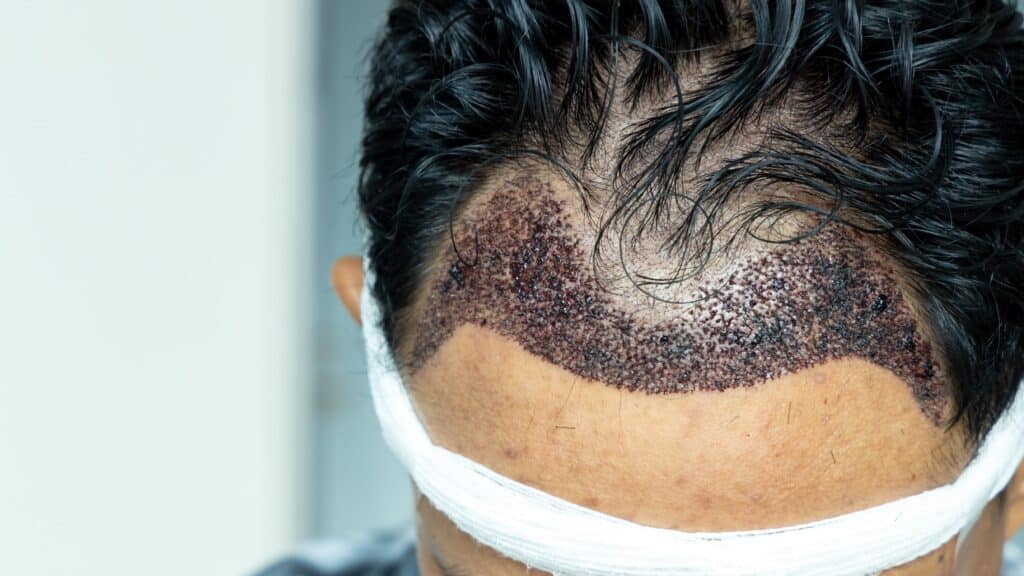
The Norwood Scale gives you a clear, structured way to understand the progression of hair loss and make informed decisions. From a slight recession in the early stages to significant bald areas in the later ones, each stage points toward different treatment priorities.
The earlier you act, the more options you have. And if you’re already at an advanced stage, modern hair transplants, especially techniques like the Micro Sapphire DHI Method, can deliver genuinely impressive results. If you’re considering your next step, reach out to Cosmedica for expert guidance from one of Istanbul’s most experienced hair transplant surgeons.
Frequently Asked Questions
Which Norwood stage am I?
The best way to determine your stage is by looking at your hairline in a mirror and checking your crown with a second mirror or a photo. If your temples form an “M” shape, you are at least a Stage 3.
Can a Norwood 7 get a hair transplant?
Yes, but expectations must be realistic. Since donor hair is limited, Dr. Acar often uses Sapphire FUE to maximize graft survival and may supplement with beard hair to achieve better coverage.
Is Stage 3 too early for a transplant?
No. Stage 3 is actually the “sweet spot” for a transplant. At this stage, your donor area is usually very strong, allowing for a high-density, permanent result that looks completely natural.