



Medically reviewed by Dr. Levent Acar, MD
Founder & Lead Hair Transplant Surgeon
Updated on: September 01, 2026
If you have landed on this page, chances are you have already spent some time in front of a mirror with the bathroom light doing you no favors. So let’s be straight with you. Norwood 6 is the stage where the two bald patches, the one creeping back from the front and the one spreading out from the crown, finally join up into one. It is the second most advanced stage of male pattern baldness, sitting one step short of the very end. The good news, and there is some, is that this stage still gives a surgeon plenty to work with. Here is what is actually going on, and what your options look like.
What Is the Hamilton Norwood Scale?
Quick bit of background first, because it helps. The Hamilton Norwood scale is the system doctors use to classify the stages of male pattern baldness. It runs from stage 1, a full head of hair, all the way to stage 7, the most advanced form of hairline recession.
Think of it as a shared map. When a surgeon says Norwood 6, every other specialist knows the exact scalp being described, no photos needed. For you, it is a way to pin down where you are and, more usefully, where things are heading.

What Does a Norwood 6 Hairline Look Like?
Here is the defining moment of this stage. The bridge of hair that used to run across the middle of your scalp, separating the receding front from the thinning crown, is gone. What is left on top is one large, uninterrupted bald area.
A few things tend to show up together in this pattern of hair loss:
- The front receding hairline has pulled back hard, temples fully on show
- That middle bridge has vanished, sometimes leaving a bit of remaining hair or peach fuzz
- The crown and the front have basically become one big open space
Around the sides and back, you keep a band of hair. That band is the early form of the horseshoe pattern everyone associates with severe hair loss, and it becomes more obvious at stage 7.
How Long Does It Take to Progress from Norwood 5 to Norwood 6?
Nobody can give you a date on the calendar, and anyone who does is guessing. Male pattern baldness runs in families, and the hormone DHT plays a role, but the pace is all over the place from one man to the next.
That said, a few patterns hold:
- Jumping from one stage to the next can take years, not months
- This stage usually turns up in men whose hair loss has been on the aggressive side
- Starting balding young, makes it more likely to reach the later stages eventually
The real difference from stage 5 is that bridge. At Norwood 5, there is still a thin, band of hair linking the front to the crown. At stage 6, it is gone, and the two bald areas open into one.
How Many Grafts Are Needed for Norwood 6 Hair Loss?
This is the question most people actually came for. The bald area is large, and the graft numbers jump accordingly compared to earlier stages.
The figures move around between clinics, but they cluster:
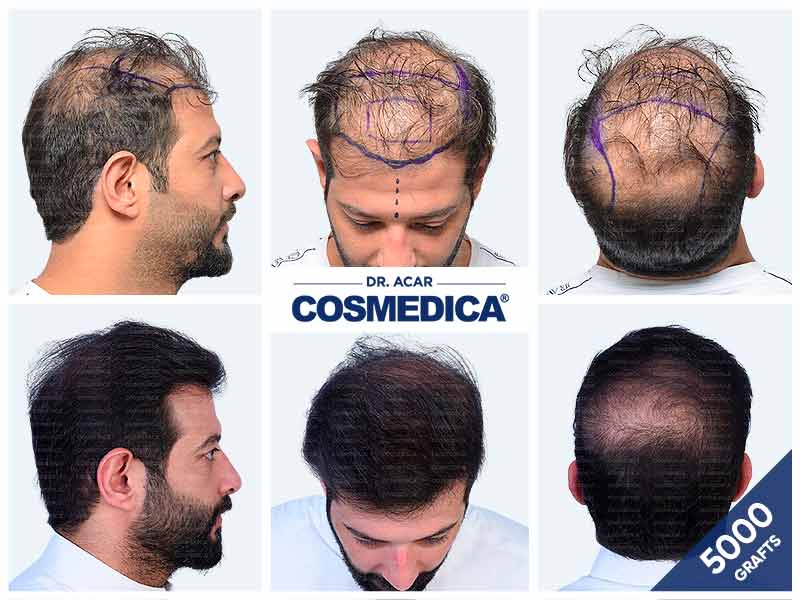
- Most surgeons land on roughly 4,000 to 6,000 grafts or more at this stage, depending on donor density and the amount of coverage you are after.
Donor supply at this stage is usually still good. Unlike Norwood 7, most patients here maintain a healthy donor area that can provide a high graft count, which is exactly why a proper hair transplant result is more realistic at stage 6 than at the final stage.
How to Treat Hair Loss at Norwood Stage 6
Hair restoration here is a planning exercise. The bald area is wide, so the smart move is to put hair where it does the most for your face, not spread it thin.
A typical plan at Norwood stage 6 looks something like this:
- A frontal hairline set at a natural height for your age, not the one you had at 18
- The front and mid-scalp are prioritized, since that is what frames your face
- The crown is blended in or saved for a second session
- Medication is kept up to protect the hair you still have
- Scalp micropigmentation, in some cases, to fake a bit of extra density
The rule every good surgeon follows is to protect the donor zone. Strip it bare, and there is no second chance, and you can not draw on the reserve. If you are weighing up a hair transplant in Turkey, this is the conversation that matters far more than the price tag.

What Hair Transplant Method Is Used at This Stage?
Method matters here because you cannot afford to waste grafts. There are two main methods of hair harvesting: FUT and FUE. FUT removes a strip of skin and is pretty outdated. FUE lifts out each follicular unit on its own with a micro punch.
At Cosmedica Clinic in Istanbul, it is only FUE and its refinement, the Micro Sapphire DHI method. The Micro Sapphire DHI approach runs in three steps:
- Hair roots come out using FUE, usually from the sides of the head
- Channels are opened with a microsapphire blade instead of a metal one, which means smaller incisions
- Roots go in with a DHI pen that keeps each graft in a protected shield
That pen lets the surgeon take a graft from extraction to placement in a single move, which protects the root along the way. The method is associated with quicker healing and a solid growth rate. If you want the full walkthrough, the Micro Sapphire DHI method page lays out every step.
What Are Realistic Norwood 6 Hair Transplant Results?
Let’s set expectations honestly, because that helps more than hype. The outlook at this stage is genuinely better than at stage 7. With a healthy donor area, a Norwood 6 hair transplant can deliver a strong, natural-looking result across the front and mid-scalp.
What is realistic usually looks like:
- A frontal hairline rebuilt to frame your face
- Decent coverage across the mid-scalp
- Crown coverage that hinges on how much donor hair hair remaining that you have to spare
- A final result that often takes two sessions to reach
The hair transplant turkey before and after gallery shows how outcomes shift across different hair loss patterns, and most people end up checking Turkey hair transplant cost against the likely graft count, since the two are joined at the hip here.
FAQ on Norwood 6 Hair Loss
Is Norwood 6 the last stage of hair loss? No. It is the second most advanced. Norwood 7 is the final one, with an even bigger bald area and a narrower band of donor hair around the sides.
Can a hair transplant fully cover a Norwood 6 scalp? Often, a strong result is on the table, but it comes down to donor supply. Many patients need two sessions, and the crown is sometimes treated differently on the front, depending on what is available.
How many grafts will I need at Norwood 6? Most estimates range from 4,000 to 6,000 grafts or more, depending on donor density and the coverage you want. Only a proper donor assessment gives you a real number.