



Medically reviewed by Dr. Levent Acar, MD
Founder & Lead Hair Transplant Surgeon
Updated on: September 01, 2026
If you’ve been tracking your hair loss and suspect you might be at Norwood 5, you’re likely dealing with a noticeable amount of thinning, and probably looking for honest answers about what you can do about it. The good news is that Stage 5 of the Norwood-Hamilton scale is highly treatable, and modern hair transplant techniques have enabled men at this stage to achieve significant, natural-looking restoration.
This article breaks down exactly what Norwood 5 means, what your scalp looks like at this stage, and what your options are going forward.
What Is the Hamilton Norwood Scale?
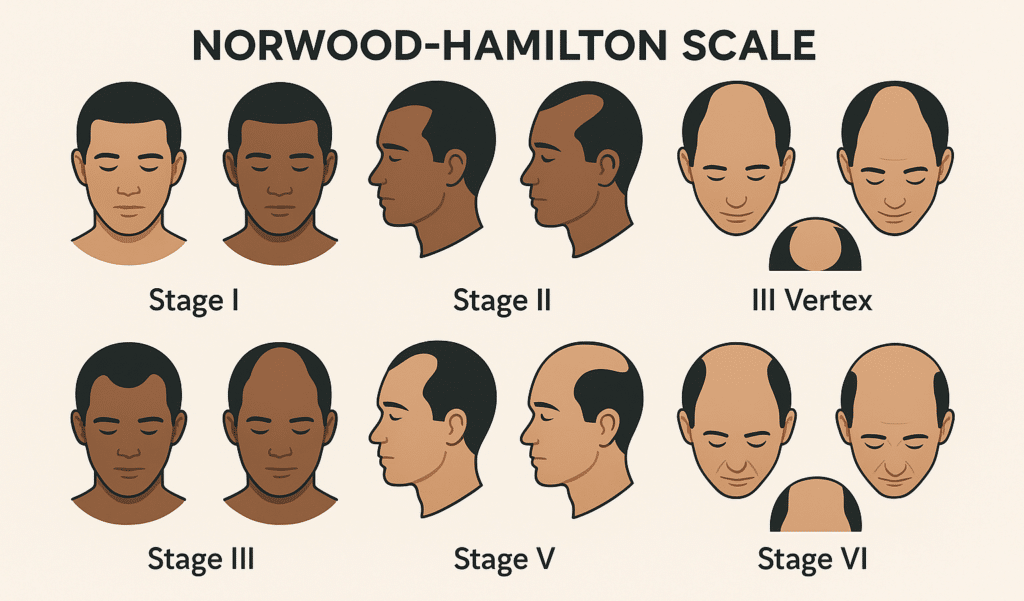
The Hamilton Norwood scale is the standard tool doctors use to classify male pattern baldness. It runs from Stage 1 (no visible hair loss) to Stage 7 (near-total baldness on top). Each stage describes a specific pattern of hair thinning and recession.
Understanding where you fall on this scale matters because it directly shapes your treatment plan.
What Does a Norwood 5 Hairline Look Like?
At Norwood 5, the bridge of hair that previously separated the front and crown balding areas starts to narrow significantly. Here’s what typically characterizes this stage:
- A wide receding hairline that has moved well back from the temples
- A large bald patch at the crown that’s expanding toward the front
- A thin strip or band of hair still connects the two areas, but barely
- Overall, hair loss covers roughly half the scalp in a horseshoe pattern
It’s a substantial amount of hair loss, but it’s important to remember that the donor zone at the back and sides usually still has plenty of healthy follicles available for transplantation. That’s a crucial factor when planning treatment.
How Long Does It Take to Progress from Norwood 4 to Norwood 5?
There’s no single answer here; male pattern baldness progresses differently for everyone. Genetics play the biggest role, but age, hormones, and overall health also matter.
That said, most men progress through the stages of male pattern baldness gradually over years, not months. Moving from Norwood 4 to Norwood 5 can take 2 to 5 years on average, though some men move faster. If you’ve noticed your hair thinning quickly over the past year, it’s worth consulting a specialist sooner rather than later.
How Can You Treat Hair Loss at Norwood Stage 5?
r progress through the stages of male pattern baldness gradually over years, not months. Moving from Norwood 4 to Norwood 5 can take 2 to 5 years on average, though some men move faster. If you’ve noticed your hair thinning quickly over the past year, it’s worth consulting a specialist sooner rather than later.
How Can You Treat Hair Loss at Norwood Stage 5?
When you are dealing with advanced hair loss, over-the-counter shampoos or basic vitamins are usually not strong enough to make a visible difference. You need a targeted, clinically proven strategy to address the root cause of the problem.
- Medical options
If you haven’t already tried medications, they can still be useful at Stage 5, not to reverse significant loss, but to preserve the hair you still have and protect the donor zone. The most commonly used options are:
- Finasteride: An oral medication that reduces DHT levels, slowing further hair loss in many men. Prescription-only.
- Minoxidil: A topical solution that helps improve blood flow directly to the remaining hair follicles, keeping them active and healthy. Minoxidil is available over the counter and is often used alongside finasteride.
- PRP therapy: Platelet-Rich Plasma (PRP) therapy uses concentrated growth factors from the patient’s own blood to stimulate hair follicles.
- Laser Therapy: Low-level laser devices can stimulate cellular activity in areas where hair is thinning but not completely gone.
- Surgical options
For most men at Norwood 5, a hair transplant in Turkey is generally the most effective long-term solution. Modern techniques can cover large bald areas with high-density and natural-looking results.

How Many Grafts Are Needed for Norwood 5 Hair Loss?
This is one of the most common questions at this stage, and the honest answer is: it depends. The size of the bald area, the density of your donor zone, and the look you’re aiming for all factor into the graft count. That said, general estimates for Stage 5 typically range from 3,000 to 5,000 grafts, sometimes more.
A consultation with an experienced surgeon is essential to help you determine the appropriate graft count.
For a detailed breakdown of costs by graft count, visit our page about the Turkey hair transplant cost.
What Do Norwood 5 Hair Transplant Results Look Like?
Results can be genuinely transformative at this stage, but managing expectations is important. A hair transplant won’t give you the hair density you had at 20. When performed well, it will restore a natural-looking hairline and add meaningful coverage to the top of the scalp.
Most patients start seeing new growth at around 3 to 4 months post-procedure. By the 12-month mark, around 90% of the final result is visible. Full maturation can take up to 18 months.
If you want to see what’s possible, our gallery of hair transplant Turkey before and after results shows real patient outcomes, including several at Norwood 5, so you can get a realistic sense of what to expect.
FAQ: Norwood 5 Hair Loss
Can Norwood 5 hair loss be reversed without surgery?
Not fully. Medications like finasteride and minoxidil can stabilize or slightly improve hair density, but they can’t regrow hair on areas that are already fully bald. Surgery is the only option for meaningful restoration at this stage.
Is Norwood 5 too advanced for a hair transplant?
No. Norwood 5 is one of the most commonly treated stages. As long as you have sufficient donor hair, a transplant is very achievable, and results can be excellent.
Will I need more than one session?
Possibly. It depends on your donor density and how far you want to take the coverage. Some patients are satisfied after one session; others opt for a second to increase density.
How long do I need to take off work after the surgery?
Most patients return to their normal office routines within five to seven days. If your job involves heavy lifting or intense physical labor, you should wait about two weeks before returning to full duty.
How do I know if I’m a good candidate?
A consultation with a qualified surgeon is the best way to assess if you’re a good candidate. Key factors include donor hair density, scalp elasticity, and the stability of your hair loss.
Is the Micro Sapphire DHI procedure painful?
The actual Micro Sapphire DHI procedure is virtually pain-free because the medical team applies local anaesthesia to your scalp beforehand. Most patients report feeling only mild pressure during the extraction and implantation process.
How long does recovery take?
Most patients return to normal activities within a few weeks, although full growth typically takes 12 months.
Is Norwood 5 the Right Time to Act?
For many men, reaching Norwood 5 is the point where doing something feels urgent. And rightly so, the earlier you address hair loss at an advanced stage, the more donor hair you typically have available to work with. Waiting longer may mean the bald area expands while the donor supply gradually thins.
Turkey offers access to experienced medical teams, advanced techniques, and competitive pricing, making hair restoration more accessible without compromising on quality. At Cosmedica in Istanbul, Dr. Levent Acar and his team provide personalized treatment plans to achieve natural-looking results.
If you’re considering restoring your hair and confidence, contact Cosmedica today to receive a free, comprehensive digital hair evaluation and explore your options.