



Medically reviewed by Dr. Levent Acar, MD
Founder & Lead Hair Transplant Surgeon
Updated on: September 01, 2026
Most men notice it during a haircut. The temples look a little higher than they did two years ago. The hairline has shifted. It is easy to put it down to lighting or a bad angle, but if it keeps happening, the change is real. Norwood Scale 2 is the first measurable stage of androgenetic alopecia. It is also the point where treatment makes the biggest difference.
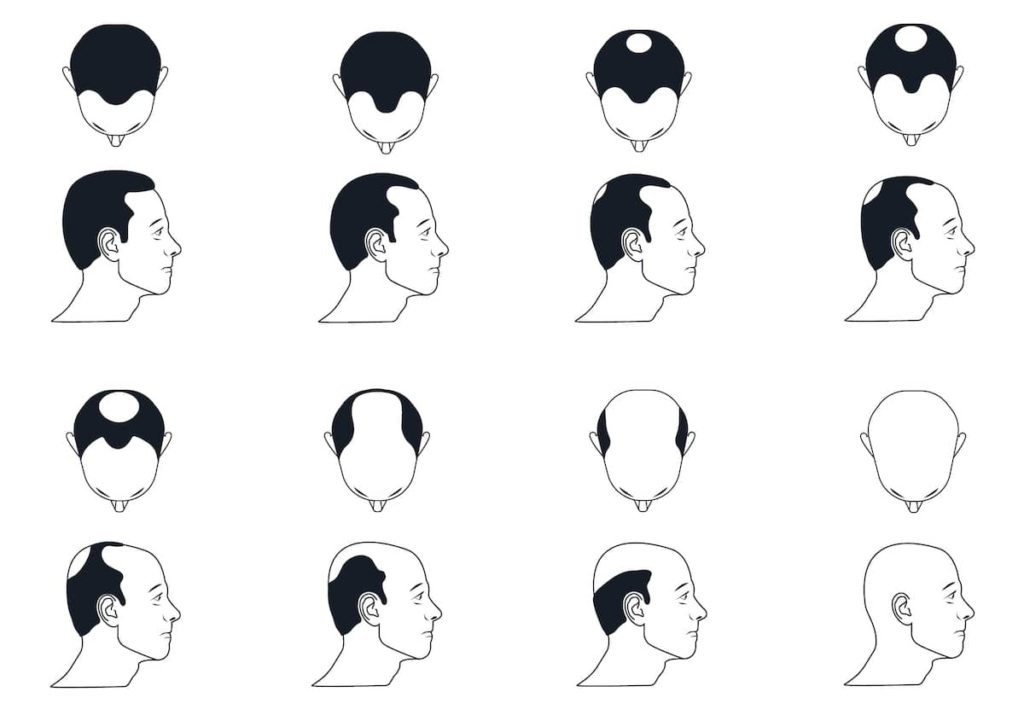
The Hamilton-Norwood Scale is the classification system doctors use to stage hair loss in men. Dr. James Hamilton created the original framework in the 1950s. Dr. O’Tar Norwood revised it in 1975. Seven stages total. Norwood stage 1, no loss at all. Stage 7, almost nothing left. According to the American Hair Loss Association, around two-thirds of men notice significant hair loss by age 35. Most of them pass through the Norwood Scale 2 first without realizing it.
Is Norwood 2 Considered Balding?
Most men notice it during a haircut. The temples look a little higher than they did two years ago. The hairline has shifted. It is easy to put it down to lighting or a bad angle, but if it keeps happening, the change is real. Norwood Scale 2 is the first measurable stage of androgenetic alopecia. It is also the point where treatment makes the biggest difference.
The Hamilton-Norwood Scale is the classification system doctors use to stage hair loss in men. Dr. James Hamilton created the original framework in the 1950s. Dr. O’Tar Norwood revised it in 1975. Seven stages total. Stage 1, no loss at all. Stage 7, almost nothing left. According to the American Hair Loss Association, around two-thirds of men notice significant hair loss by age 35. Most of them pass through the Norwood Scale 2 first without realizing it.
Is Norwood 2 Considered Balding?
Technically, no. Norwood defined stage 3 as the minimum to be called balding. Stage 2 sits below that. But the receding hairline is already there. Already visible. Without treatment, hair loss tends to progress.
Stage 2 is where the treatment options are widest. That matters more than the label itself.
What Does a Norwood 2 Hairline Look Like?
The frontal hairline begins to pull back at the temples. Usually triangular, usually symmetrical. Both sides of the head move at roughly the same pace. Viewed from above, it begins forming a subtle M or V. No thinning at the top of the head. No crown loss yet.
What to look for:
- Temples sitting noticeably further back than a few years ago
- A more prominent central peak along the frontal hairline
- Recession on one side of the head or both
- No hair loss at the vertex
A lot of men at this stage wonder whether it is a mature hairline or something more serious. A mature hairline shifts in your twenties and then stops. A receding hairline driven by androgenetic alopecia does not stop. A trichologist can tell the difference with a scalp analysis.
Stage 2 is where the treatment options are widest. That matters more than the label itself.
How Long Does Norwood 2 Last?
Depends entirely on genetics, DHT levels, and treatment. Some men hold at stage 2 for a decade. Others move through the stages of male pattern baldness in under two years without even registering the change until it is stage 4.
A population-based study in the International Journal of Trichology found that male androgenetic alopecia affects around 58% of men aged 30 to 50, with severity climbing steadily with age. Finasteride research shows that around 65% of users maintain or improve density over five years. Those results are strongest in men who started early.
Nobody can tell you exactly how fast your hair loss will progress. What the research does tell us is that stage 2 is the point at which hair loss is still reversible for many men.
How Do You Treat Hair Loss at Norwood Stage 2?
Always remember, medical treatment comes first. So let us look at the main options.
- Finasteride (1mg daily, oral) blocks DHT conversion. DHT is the hormone responsible for male pattern hair loss and follicle miniaturization over time. Studies show it stabilizes or improves density in about 85-90% of men when started at this early stage.
- Minoxidil (topical, twice daily) extends the active growth phase of each follicle and improves blood flow to the scalp. It does not target DHT directly. Most doctors combine it with finasteride rather than prescribe it alone.
Some patients add in:
- PRP therapy: growth factors from the patient’s own blood injected into the scalp
- Low-level laser therapy: light-based follicle stimulation
- Dietary support: protein, iron, and zinc are consistently linked to follicle health
Hair restoration through these methods is a long game. Six to twelve months before results are clear. But at stage 2, most patients are still in a position where this can genuinely hold things in place.
Jacob Kolosov, a patient of Dr. Acar at Cosmedica, summed up what the hair transplant in Turkey consultation process feels like: “Dr. Acar is absolutely amazing. He makes you feel confident in the process. All my questions were answered.”

How Many Grafts Are Needed for a Norwood 2 Hair Transplant?
Surgery is not the default at this stage. Most surgeons want to see a stable recession before touching it. A Norwood 2 hair transplant becomes relevant when medication has not been enough, or when a patient wants a permanent result rather than ongoing treatment.
Graft counts at stage 2 are low. Most patients need 800 to 1,500. Some wider hairline designs push to 2,000, but that is not common for Norwood 2. The procedure runs 4 to 6 hours. Recovery is faster than at later stages. Most patients are back to a desk job within a few days.
One thing every patient should understand before deciding: the transplanted follicles are DHT-resistant and grow permanently. The native hairs around them are not protected. If you stop medication after surgery, the hair around the area keeps receding. The transplant holds. The rest does not. Post-surgical medication is not optional.
The Turkey hair transplant cost page at Cosmedica breaks down pricing by graft count, so you can understand what different options look like financially.
What Do Norwood 2 Hair Transplant Results Look Like?
Small treatment zone. Dense donor area. Focused goal. Those three things together make Norwood 2 one of the cleaner procedures in hair restoration surgery.
At Cosmedica Clinic, Dr. Levent Acar uses the Micro Sapphire DHI technique for hairline procedures at this stage. A sapphire blade creates finer incisions than a standard metal blade. The DHI implanter pen places each graft at the angle and direction it needs to grow naturally. For frontal hairline work, that precision is what determines whether the result looks real.
New growth starts appearing from months 3 to 4. Most patients see clear improvement by month 6. Full assessment at 12 months.
Keiran Lee, British actor and Cosmedica patient, described the result like this: “I felt like a 25-year-old Keiran again. It was unbelievable that I could look in the camera again and see my hair, flowing locks. It just looked perfect.”
To see real patient outcomes, view hair transplant Turkey before and after photos from Cosmedica.
FAQ: Norwood Scale 2 Hair Loss
Is Norwood 2 something to worry about?
It is early-stage hair loss. Not balding by definition. But androgenetic alopecia has started, and stage 2 is genuinely the best moment to address it; the options narrow as the stages progress.
Will it always get worse? Not necessarily, but without treatment it usually does. A strong family history of significant hair loss increases the likelihood of progression. Medication changes that picture for a lot of men.
Can I get a hair transplant at Norwood 2?
Yes. A Norwood 2 hair transplant has a high success rate and produces some of the most natural results in the field. Most surgeons recommend stabilizing with medication first.
Is it a mature hairline or Norwood 2?
Mature hairlines shift in early adulthood and stop. A Norwood 2 receding hairline caused by androgenetic alopecia will not stop on its own. Get a specialist to look at it; the distinction matters for what comes next.
How many grafts do I need?
Usually 800 to 1,500. Depends on the depth of the recession and what you want the hairline to look like. That gets decided during consultation.
Which technique is suited to Norwood 2?
Both FUE and DHI work well at this stage. The Micro Sapphire DHI method offers greater control over graft angle and direction, which is worth it for frontal hairline work where the results are seen up close every day.