



Medically reviewed by Dr. Levent Acar, MD
Founder & Lead Hair Transplant Surgeon
Updated on: September 01, 2026
So, you’ve heard about the Norwood Scale, and you’re wondering if you fall into Norwood Scale 1. Maybe you’ve spotted a few hairs on your pillow, or your barber mentioned your hairline looks a little higher than before.
Either way, you’re here to get the facts, and that’s a smart move. Understanding where you sit on the stages of the Norwood scale is the first step toward managing hair loss in men, even if “doing something” right now just means keeping a close eye on things.
What Is Norwood Scale 1?
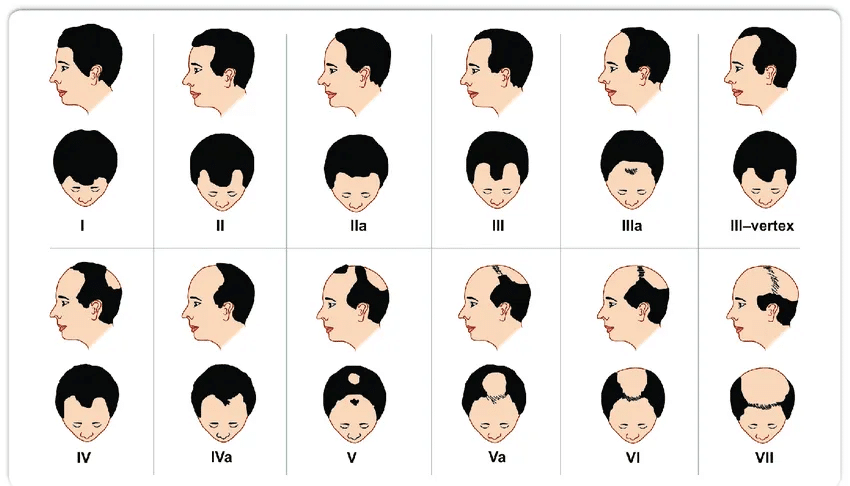
The Norwood Scale, officially called the Hamilton-Norwood Scale, is a seven-stage system used to classify male pattern hair loss. Stage 1 is the baseline. It represents a full, intact hairline with no visible recession or thinning.
That said, being at Norwood 1 doesn’t necessarily mean you’ll stay there. For men with a genetic predisposition to androgenetic alopecia or hereditary hair loss, this stage can quietly transition into Norwood Stage 2 over months or years. Most men don’t even notice the shift until they’re past it.
Does Norwood 1 Mean You’re Going Bald?
Not necessarily. Being at Norwood Scale 1 simply means there’s no noticeable hair loss right now. Plenty of men stay at or near this stage their entire lives, especially if hair loss doesn’t run strongly in their family. But here’s the honest truth: if you’re checking the scale in the first place, you may have a reason to monitor things more closely.
Important things to look out for include:
- A receding hairline that seems to be moving back gradually at the corners
- More hair than usual in the shower drain or on your pillow
- Thinning around the temples or crown that’s just starting to appear
What Does a Norwood 1 Hairline Look Like?
A Norwood 1 hairline follows the natural curve along the front of the scalp, sitting low and even across the forehead. There’s no recession at the temples, no thinning at the crown, and hair density is consistent from front to back.
At this stage, you still have a solid, uninterrupted band of hair framing your face. The amount of hair remaining is essentially what you’d expect from a young adult who has not experienced any pattern thinning.
How to Tell if You’re Norwood 1 or Norwood 2?
Differentiating between these initial two stages of male pattern evolution can occasionally get tricky. The line between Stage 1 and Stage 2 can be subtle, especially in the early going. Here’s a rough way to think about it:
- Norwood 1: Hairline is full and intact. No visible recession at the temples or forehead.
- Norwood 2: Slight recession begins at the temples, creating a mild M-shape. The hairline is still relatively high and intact, but movement is visible.
The easiest way to check? Compare photos of yourself taken a year or two apart. If your hairline looks the same, you’re probably still at Stage 1. If there’s a noticeable shift at the temples, you may have crossed into Stage 2, and that’s when it’s worth speaking to a professional.
How Can You Treat Hair Loss at Norwood Stage 1?
At Norwood Scale 1, there’s technically nothing to “treat” since active balding areas haven’t formed yet. But if you’re genetically at risk, this is actually the ideal time to be proactive. Early-stage hair loss treatments tend to be far more effective than trying to reverse significant hair loss later.
Lifestyle habits can support scalp health and reduce unnecessary shedding. Helpful steps include:
- Eating a balanced diet
- Managing stress levels
- Avoiding smoking
- Using gentle hair care products
What Medication Can You Use in the Early Norwood Stages?
Medication is often most effective during the earliest stages of hair thinning. Starting treatment before major follicle damage occurs may slow progression and preserve density longer.
The two most common medications are:
- Minoxidil: Minoxidil is a topical treatment applied directly to the scalp. It may improve blood flow around hair follicles and encourage stronger hair growth.
- Finasteride: Finasteride is an oral medication that lowers DHT levels. DHT is a hormone strongly linked to androgenetic alopecia and male pattern balding.
What Is Follicle Stimulation and Does It Help at Norwood 1?
Follicle stimulation refers to treatments that encourage dormant or sluggish hair follicles to become more active. At Norwood Stage 1, your follicles are still fully functioning, but stimulation techniques can help keep them that way for longer.
Common stimulation options include:
- Platelet-Rich Plasma (PRP) therapy: A procedure where a small amount of your own blood is drawn, processed in a centrifuge to concentrate the platelets, and then injected back into the scalp. These platelets release growth factors that may help stimulate weak hair follicles, improve scalp circulation, and support early-stage hair loss treatments.
- Scalp microneedling: Creates micro-channels in the scalp that can enhance the absorption of topical treatments like minoxidil.
Low-Level Laser Therapy (LLLT): LLLT is an increasingly popular non-invasive method. This light therapy uses safe medical-grade red lasers to boost cellular activity and enhance blood flow directly around the roots. Devices range from clinical machines to at-home laser combs and helmets.

Is a Hair Transplant to Norwood 1 Possible?
Yes, and it’s actually one of the most common goals for men seeking hair restoration. If you’ve progressed beyond Stage 1 and want to return to a full, natural hairline, a hair transplant in Turkey can make that possible. The key is working with a surgeon who understands hairline design and can recreate a Norwood 1 hairline naturally.
At Cosmedica in Istanbul, Dr. Levent Acar, a hair transplantation specialist with over 16 years of experience, specializes in exactly this. His primary technique is the Micro Sapphire DHI Method, a refined technique that combines Direct Hair Implantation with micro-sapphire-tipped instruments for greater precision and gentler handling of grafts. The result is a faster recovery, higher growth rate, and a hairline that looks genuinely natural.
Curious about outcomes? Browse real patient results on the hair transplant Turkey before and after gallery.
It’s worth noting that hair transplants are generally most effective when the donor area, usually the back and sides of the scalp, still has strong, healthy follicles. This is another reason why catching things early matters. The more hair remaining in the donor zone, the more options you have.
Why Do Many Patients Choose Turkey for Hair Restoration?
Turkey has become a leading destination for modern hair restoration procedures. Many international patients travel there because clinics offer experienced medical teams, advanced techniques, and more affordable pricing compared to the US or UK.
For many people, the Turkey hair transplant cost makes treatment more accessible while still providing high clinical standards and personalized care.
At Cosmedica’s state-of-the-art clinic in Istanbul, treatment plans are tailored to each patient’s hairline, facial proportions, and long-term hair-loss pattern.
Takeaway for Norwood Scale 1
Being at Norwood Scale 1 is genuinely good news; it means your hair is intact and your options are wide open. If you have a family history of androgenetic alopecia, now is the time to be proactive rather than reactive. Simple steps like monitoring your hairline, speaking to a doctor about preventive medication, and keeping your scalp healthy can make a real difference over time.
And if you ever progress beyond Stage 1 and decide to explore hair restoration options, modern techniques like FUE and the Micro Sapphire DHI Method can deliver results that look completely natural. The earlier you understand the stages of male pattern baldness, the better equipped you’ll be to manage them on your own terms. The team at Cosmedica is always here to help you understand your options clearly. Contact us today to secure a free, comprehensive digital hair evaluation.