



Medically reviewed by Dr. Levent Acar, MD
Founder & Lead Hair Transplant Surgeon
Updated on: September 01, 2026
The hair growth cycle has three phases: anagen (active growth), catagen (a short transition), and telogen (resting, followed by eventual shedding). Every follicle runs this cycle on its own independent timeline, which is why you never grow or shed all your hair at once.
Losing hair every day is normal. Most people shed somewhere between 50 and 100 scalp hairs daily, a range commonly cited by the American Academy of Dermatology. This simply reflects a portion of follicles reaching the end of telogen at any given time. This guide walks through each phase, how long the cycle typically takes, and how to tell ordinary shedding apart from patterns that may be worth a professional look.
The Three Phases of the Hair Growth Cycle
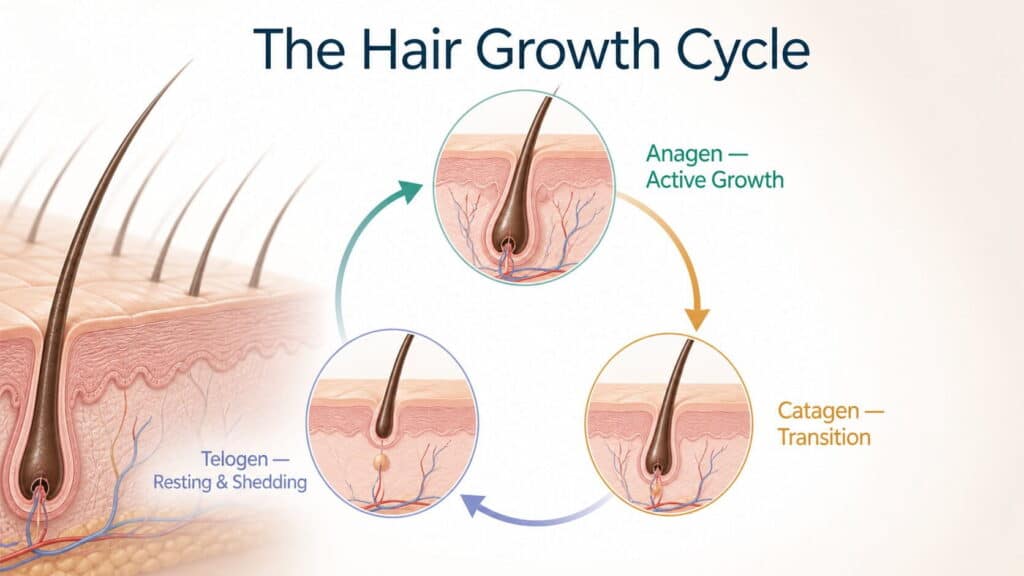
Each hair follicle moves through three distinct phases on repeat, for as long as it remains active.
| Phase | What happens | What the reader may notice | Typical duration |
|---|---|---|---|
| Anagen | The follicle actively produces a hair shaft. | Hair continues to grow in length. | Often years for scalp hair |
| Catagen | Growth slows and the follicle enters a short transition period. | Little visible change may occur. | A few weeks |
| Telogen | The follicle rests before the old hair sheds and a new cycle begins. | Some shedding may occur. | Roughly 2 to 4 months |

Anagen phase: active growth
Anagen is the growth phase. During this time, cells in the follicle divide rapidly, producing a hair shaft that lengthens steadily. This is the phase responsible for how long your hair can ultimately grow. To understand what a follicle actually looks like during this process, see what a hair follicle is and how it works.
The duration of anagen varies considerably from person to person and even from one area of the body to another. Scalp hair typically stays in anagen far longer than eyebrow or eyelash hair, which is part of why eyebrows and lashes never grow as long as scalp hair. Genetics, age, and overall health can all influence how long an individual follicle remains in this active phase, and by extension, how long that hair can grow before it moves on to the next stage.
Catagen phase: transition
Catagen is a brief transitional phase. The follicle stops actively producing new hair and begins to shrink, detaching from its blood supply. Because this phase is comparatively short, it does not usually cause any noticeable change in day-to-day hair appearance. You are unlikely to see or feel anything different while a given follicle is in catagen.
At any given time, only a small fraction of scalp follicles, roughly 1–2%, are in catagen. Because catagen is a brief transitional phase and most follicles are in anagen or telogen, its effects are usually not noticeable as a distinct scalp-wide event.
Telogen phase: rest and shedding
Telogen is the resting phase. The old hair is no longer anchored as firmly and eventually sheds, usually to make room for a new anagen hair growing underneath it. Not every hair in telogen falls out immediately, and not every strand you lose is a sign of anything unusual. This is the phase most closely tied to ordinary daily shedding.
Common Causes of Increased Shedding and Typical Recovery Patterns
Not all shedding behaves the same way. Some triggers resolve on their own within a predictable window, while others tend to persist or worsen without intervention. The table below summarizes common patterns, though individual experiences vary and this is not a diagnostic tool.
| Trigger | Typical onset of shedding | Usually temporary or persistent? |
|---|---|---|
| Illness, fever, or surgery | 6 to 12 weeks after the event | Usually temporary |
| Pregnancy or postpartum | 2 to 4 months postpartum | Usually temporary |
| Major weight loss | 3 to 6 months after | Usually temporary |
| Chronic or ongoing stress | Weeks to months, variable | Can persist if the stressor continues |
| Pattern hair loss (genetic) | Gradual and progressive | Persistent, typically progressive |
If shedding follows a temporary trigger, it often settles once the underlying cause resolves. If it is gradual, progressive, and not tied to an identifiable event, it is more likely to reflect a pattern that benefits from professional assessment. For a deeper look at genetic thinning specifically, see the reasons behind hair loss and how male pattern baldness progresses.
Telogen Effluvium: When Shedding Increases Temporarily

Telogen effluvium describes a temporary increase in the number of hairs entering the telogen (resting and shedding) phase at the same time, usually in response to a triggering event such as illness, significant stress, childbirth, or a major change in the body. It is one of the more common reasons people notice a sudden uptick in shedding without any change to their hairline or overall density pattern.
Because telogen typically lasts 2 to 4 months, the shedding often shows up weeks or months after the trigger itself, rather than immediately. This delay is one of the main reasons people struggle to identify a cause: by the time hair is visibly falling out, the event that set it off may already feel like old news.
Because telogen effluvium affects the timing of the cycle rather than damaging the follicle, it is generally temporary and resolves once the trigger passes. That said, outcomes depend on the underlying cause, and it can occasionally overlap with other forms of hair loss. Shedding that continues for more than six months or shows no signs of slowing is worth having assessed rather than assumed.
How a Hair-Loss Consultation Can Help
Whether any treatment, including a hair transplant, is appropriate depends on the underlying cause, the pattern and extent of loss, the condition of the donor area, and the person’s individual goals. Not every type of thinning is suited to transplantation, and a transplant does not address temporary shedding tied to a resolving trigger.
If thinning or shedding has been persistent or progressive rather than a short-term blip, a hair-loss consultation can help put the pieces together.
This typically involves reviewing:
- The pattern and duration of hair loss
- The condition and density of the donor area
- Hairline and density goals, if relevant
- Any medical or lifestyle history that might be contributing
- Whether further medical evaluation is warranted
- Whether a hair transplant could be a reasonable option
- Which technique might be considered, if transplantation is suitable
At Cosmedica, consultations for a hair transplant in Turkey associated with Dr. Levent Acar focus on understanding the individual pattern of hair loss and whether a treatment plan may be appropriate, not on assuming that every case of shedding calls for surgical intervention.
If you’re noticing persistent thinning, a changing hairline, or ongoing increased shedding and aren’t sure what it means, a personalized hair assessment can help clarify your options. Cosmedica offers a free hair analysis for people exploring their next step, with no assumption that a transplant is the outcome.
For those who reach the point of considering treatment, it can help to look at how FUE, DHI, and Micro Sapphire DHI differ, along with hair transplant before and after examples, to understand how candidacy and planning actually work. Current Turkey hair transplant cost is also available for those comparing options.
Frequently Asked Questions
What are the three phases of the hair growth cycle?
Anagen (active growth), catagen (a short transition), and telogen (resting, with eventual shedding).
How long is the hair growth cycle?
It varies by individual and by follicle. Anagen is usually the longest phase, often lasting years for scalp hair, while catagen lasts weeks and telogen lasts months. There is no single timeline that applies to everyone.
Is hair shedding during the telogen phase normal?
Some shedding is a normal, expected part of the growth cycle. A sudden increase or a pattern that persists for months is more worth having assessed.
Is it normal to lose more hair in autumn or winter?
Some people experience a mild, temporary increase in shedding in late summer or autumn. This is not universal, and shedding that feels unusually heavy or does not settle down is worth discussing with a professional.
Can stress affect the hair growth cycle?
Significant physical or emotional stress may be associated with increased shedding in some people, often with a delay before it becomes noticeable. The connection and its severity vary from person to person.
Does telogen effluvium cause permanent hair loss?
Not necessarily. The course often depends on the underlying trigger and whether another form of hair loss is present alongside it. It is not possible to give a universal answer without individual evaluation.
How long does telogen effluvium last?
It commonly lasts around 3 to 6 months from the point shedding becomes noticeable, though this depends on the trigger and whether it has fully resolved. If the underlying cause continues, shedding can persist longer than the typical window.
Can the hair growth cycle be restarted or sped up?
The cycle itself is a biological process that cannot be forced into a faster rhythm. What can sometimes be addressed is an underlying disruption, such as a nutritional deficiency or a resolving stressor, which may allow follicles to return to their normal rhythm sooner. There is no reliable way to speed up anagen itself beyond what an individual’s biology allows.
Can supplements restart the hair growth cycle?
Supplements do not work the same way for everyone and are not a substitute for identifying an underlying cause. They may help when a genuine deficiency has been confirmed by a healthcare professional.
How can I tell whether my hair is shedding or breaking?
Shed hairs typically come out with a small bulb at the root, while broken hairs usually show a blunt or frayed end partway along the shaft. If it is unclear, a professional evaluation can help.
When should I see a professional about hair shedding?
Consider an evaluation if shedding is sudden, persistent, progressively worsening, patchy, or accompanied by scalp symptoms or other health changes.