



Medically reviewed by Dr. Levent Acar, MD
Founder & Lead Hair Transplant Surgeon
Updated on: September 11, 2026
Medically reviewed by Dr. Levent Acar, MD
Founder & Lead Hair Transplant Surgeon
Updated on: September 11, 2026
Interest in RU58841 has increased steadily in online hair loss communities, particularly among individuals who are already familiar with established treatments such as finasteride and minoxidil. As a result, many patients desire to understand how this compound compares mechanistically and clinically to finasteride.
This article provides a science-focused, cautious comparison of RU58841 and finasteride, with an emphasis on biological plausibility, quality of evidence, and safety considerations. The goal is not to promote either compound, but to clearly outline what is known, what is uncertain, and where important gaps in evidence remain.
Medical disclaimer: RU58841 is not an FDA-approved medication and is not authorized for human use. This article is for educational purposes only and should not be interpreted as medical advice.
How Male Pattern Baldness Works
Male pattern baldness, clinically referred to as androgenetic alopecia, is a progressive condition driven by androgen signaling in genetically susceptible scalp hair follicles. While testosterone is often discussed in this context, the primary androgen involved is dihydrotestosterone (DHT), a more potent derivative of testosterone formed through the action of the enzyme 5α-reductase.
The pathological process depends on several interacting factors rather than a single hormone alone:
- Conversion of testosterone to DHT by 5α-reductase
- Binding of DHT to androgen receptors in scalp follicles
- Genetic sensitivity of those receptors to androgen signaling
Once activated, androgen receptors trigger changes in gene expression that shorten the hair growth cycle and progressively miniaturize follicles. Over time, this leads to thinner, shorter hairs and visible scalp thinning.
What Is RU58841?
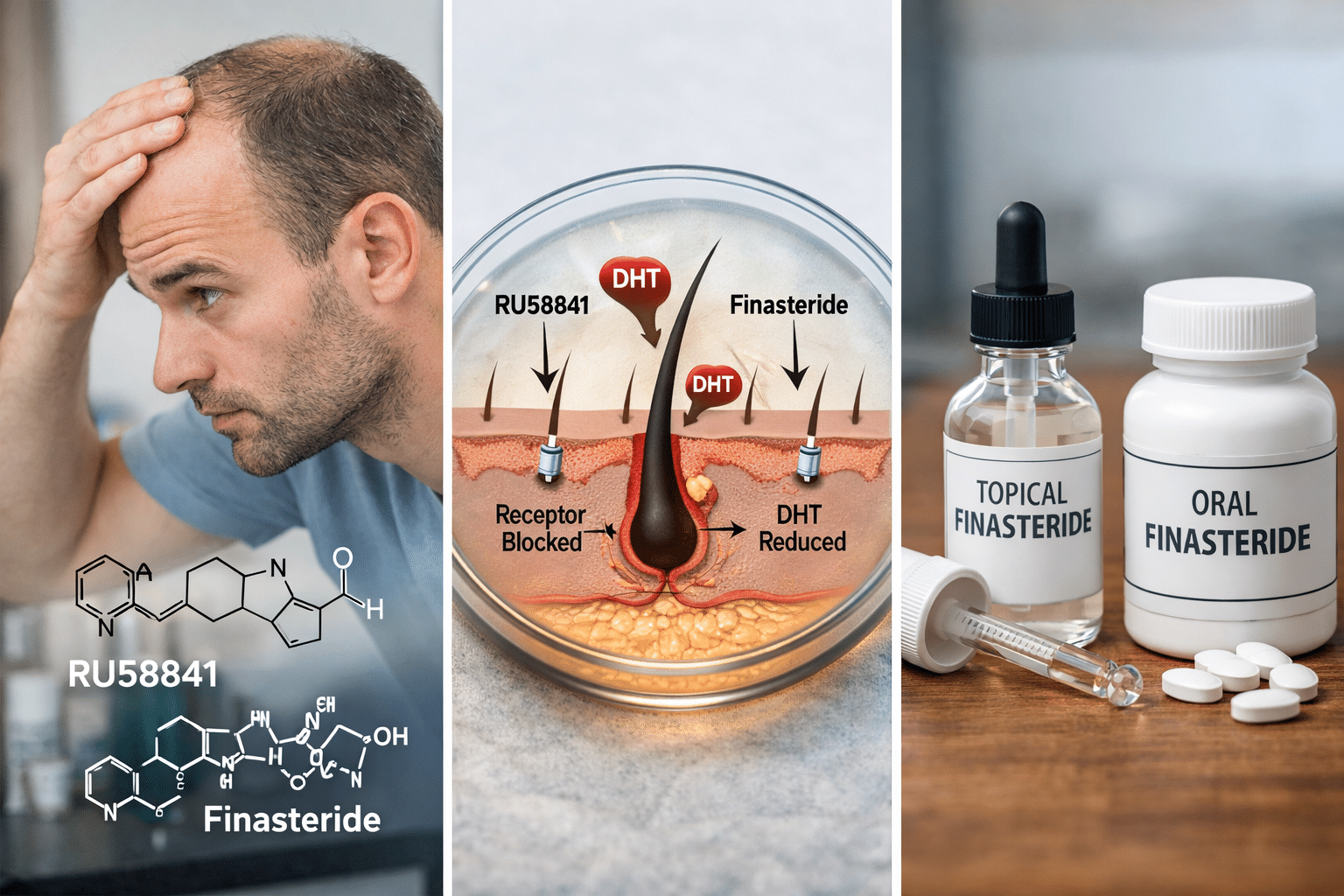
RU58841 is a non-steroidal androgen receptor antagonist that was investigated in the 1990s as a potential topical treatment for androgen-dependent conditions. Unlike finasteride, RU58841 does not interfere with androgen production. Instead, it competes directly with androgens for binding at the androgen receptor.
Its proposed advantages are primarily theoretical and include:
- Localized androgen receptor blockade at the scalp
- No direct suppression of systemic DHT production
- Potential preservation of normal androgen physiology
Despite these theoretical benefits, RU58841 never progressed through late-stage human clinical trials. Development was discontinued, and comprehensive human safety and efficacy data were never established.
What Is Finasteride?
Finasteride is an orally administered medication approved by the U.S. Food and Drug Administration for the treatment of male pattern hair loss. Its mechanism of action involves inhibition of type II 5α-reductase, thereby reducing the conversion of testosterone into DHT.
This mechanism produces several well-documented physiological effects:
- Significant reduction in serum DHT levels
- Partial reduction in scalp DHT concentrations
- Indirect decrease in androgen receptor activation
Multiple large randomized controlled trials have demonstrated that these effects are sufficient to slow or halt hair loss progression in a significant proportion of men, particularly in the crown and mid-scalp regions. The clinical profile of finasteride is well understood due to decades of use and post-marketing surveillance.
RU58841 vs Finasteride: Mechanism Differences
Both finasteride and RU58841 aim to reduce androgen receptor activation in hair follicles, but they intervene at different points along the androgen signaling pathway.
This distinction can be summarized as follows:
- Finasteride acts upstream by reducing DHT availability
- RU58841 acts downstream by blocking receptor activation
- Both approaches ultimately target androgen-mediated follicle miniaturization
While receptor-level blockade may appear more targeted, it also introduces uncertainty regarding long-term receptor interference and systemic exposure, particularly in the absence of large human trials.
What Does the Research Show on RU58841 vs Finasteride?
Most comparisons between RU58841 and finasteride rely on preclinical models or early-stage human research rather than modern randomized trials.
The available evidence can be broadly categorized into:
- Animal studies demonstrating localized anti-androgen effects
- Small early human trials with limited duration and sample size
- Absence of contemporary head-to-head clinical comparisons
From an evidence-based medicine perspective, this lack of robust human data significantly limits the conclusions that can be drawn regarding comparative efficacy.
Side Effects and Safety: Finasteride vs RU58841
Finasteride’s safety profile is well characterized due to extensive clinical use. Reported side effects primarily stem from its systemic hormonal effects, particularly with oral administration.
These considerations include:
- Sexual side effects in a minority of users
- Measurable changes in circulating androgen levels
- Extensive long-term observational data
In contrast, RU58841 lacks comparable human safety data. Claims of minimal systemic absorption are based largely on animal research and anecdotal reporting. Without pharmacokinetic studies in humans, systemic exposure cannot be reliably excluded, especially with chronic topical use.
Topical vs Oral Finasteride: Safety and Systemic Exposure
Finasteride is most commonly prescribed as an oral medication, though topical formulations are increasingly used in clinical practice as a means of reducing systemic exposure while targeting the scalp. This distinction is relevant when comparing finasteride with experimental topical anti-androgens such as RU58841.
Finasteride is most commonly prescribed as an oral medication, though topical formulations are increasingly used in clinical practice as a means of reducing systemic exposure while targeting the scalp. This distinction is relevant when comparing finasteride with experimental topical anti-androgens such as RU58841.
From a clinical perspective, topical finasteride represents a regulated, evidence-supported modification of an established therapy, rather than a separate pharmacologic class. Long-term safety data continue to evolve, and both formulations require appropriate medical oversight.
Is RU58841 Safer or More Effective Than Finasteride?
There is currently no high-quality evidence demonstrating that RU58841 is either safer or more effective than finasteride. While its mechanism is biologically plausible, plausibility alone does not equate to clinical validation.
From a scientific standpoint:
- Finasteride has demonstrated efficacy and known risks
- RU58841 has theoretical benefits but unknown long-term safety
- Direct comparisons are not supported by robust data
As a result, claims of superiority remain speculative.
Choosing Between RU58841 and Finasteride
In regulated medical practice, treatment recommendations are guided by evidence quality, safety data, and regulatory approval. Finasteride meets these criteria; RU58841 does not.
This distinction is particularly relevant for patients considering hair transplantation, where long-term hair preservation is critical. Pharmacologic therapies are used to stabilize existing hair rather than replace it, making predictability and safety central considerations.
Conclusion
Finasteride remains the most extensively studied androgen-targeting treatment for male pattern hair loss. RU58841 represents an intriguing research concept focused on androgen receptor antagonism, but one that remains incomplete from a clinical standpoint.
Until high-quality human trials are available, RU58841 should be viewed as an experimental compound rather than a validated medical therapy. For patients, clinicians, and researchers, the distinction between theoretical potential and demonstrated clinical benefit remains essential.
Frequently Asked Questions About RU58841 and Finasteride
What is RU58841 used for?
RU58841 is an experimental androgen receptor antagonist studied for androgenetic alopecia. It is designed to block androgen signaling at the hair follicle rather than reduce hormone levels. RU58841 is not approved for medical use and lacks large-scale human clinical trials.
Is RU58841 FDA approved?
No, RU58841 is not FDA approved. It was never authorized for the treatment of hair loss or any medical condition and did not complete late-stage human clinical trials required for regulatory approval.
Is RU58841 safer than finasteride?
There is no evidence showing that RU58841 is safer than finasteride. While it is intended to act locally, long-term human safety data are lacking. Finasteride’s risks are better understood due to decades of clinical research and use.
Does RU58841 cause the same side effects as finasteride?
RU58841 and finasteride have different mechanisms, so their side effects cannot be directly compared. Finasteride affects systemic hormone levels, while RU58841 targets the androgen receptor. The full side effect profile of RU58841 in humans remains unknown.
Can RU58841 be used with finasteride?
There is no clinical evidence supporting the combined use of RU58841 and finasteride. Although they act at different points in androgen signaling, combination therapy has not been formally studied in humans.
Is RU58841 effective for hair regrowth?
There is no strong evidence that RU58841 reliably causes hair regrowth in humans. Available data suggest it may help limit further follicle miniaturization, but large controlled studies demonstrating regrowth are lacking.
Is RU58841 suitable for women?
There is insufficient evidence to determine whether RU58841 is safe or effective for women. Its effects on androgen receptors and potential systemic absorption in women have not been adequately studied.
Why was RU58841 discontinued?
The exact reason RU58841 development was discontinued is not publicly documented. Available information suggests it did not progress through late-stage clinical trials, but definitive regulatory or safety conclusions are unavailable.
Is finasteride still the gold standard for hair loss?
Yes, finasteride remains a first-line treatment for male pattern hair loss. Its effectiveness and risks are supported by multiple randomized controlled trials and long-term clinical data.