



Medically reviewed by Dr. Levent Acar, MD
Founder & Lead Hair Transplant Surgeon
Updated on: September 11, 2026
Norwood-Hamilton classification is the most widely used hair loss classification. It’s the visual language that hair specialists use to classify and track stages of hair loss, from the first subtle signs of thinning to near-complete baldness.
At Cosmedica Clinic in Istanbul, Dr. Levent Acar uses this system to assess every patient’s unique pattern of hair loss before recommending a personalized hair transplant Turkey plan. This approach ensures that each treatment isn’t just cosmetic, it’s tailored to the biology, pattern, and progression of the individual.
What Is the Hamilton Scale?
Hamilton studied more than 700 individuals of various sex, ethnicities, and ages to create the first hair loss classification. The Hamilton classification is divided into two major categories: scalp which are “not bald” and “bald.”
However, Hamilton classification of male pattern hair loss is not without its drawbacks. One of the Hamilton’s types of MPHL, type III was described as borderline cases or cases which are difficult to assess. This type basically serves as a basket criteria for other types of scalp that did not fit the different types. This classification is thus unable to observe stages of hair loss accurately.
Who Invented the Modern Norwood Hamilton Scale?
In 1975, Dr. Norwood studied 1000 Caucasian male individuals by using the Hamilton classification as a guide. He then modified the classification to create the Norwood-Hamilton classification that conforms better to the observed stage of hair loss.
This classification simplified Hamilton classification. It also removed the basket criteria of type III that may cause confusion.
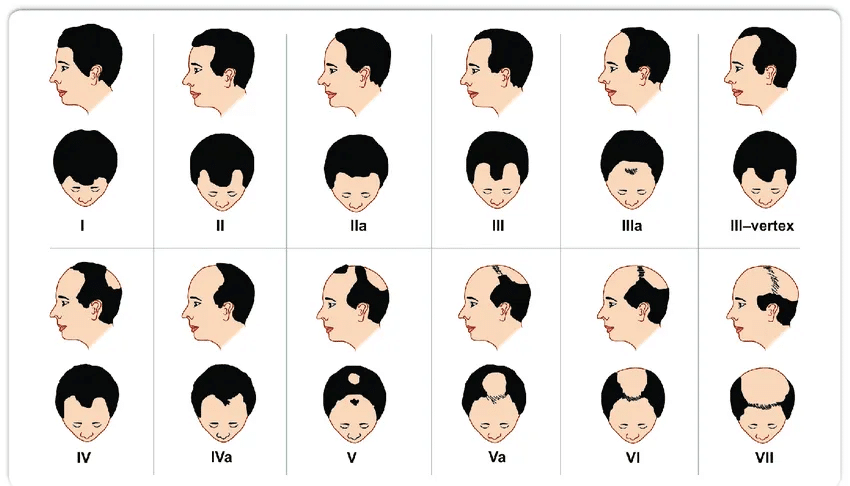
Think of it as a roadmap that shows the stages of male pattern hair loss over time. It starts with small shifts like the hairline recedes and ends with a distinctive horseshoe-shaped band of hair remaining on the sides.
What Is the Hamilton Scale?
Hamilton studied more than 700 individuals of various sex, ethnicities, and ages to create the first hair loss classification. The Hamilton classification is divided into two major categories: scalp which are “not bald” and “bald.”
However, Hamilton classification of male pattern hair loss is not without its drawbacks. One of the Hamilton’s types of MPHL, type III was described as borderline cases or cases which are difficult to assess. This type basically serves as a basket criteria for other types of scalp that did not fit the different types. This classification is thus unable to observe stages of hair loss accurately.
Who Invented the Modern Norwood Hamilton Scale?
In 1975, Dr. Norwood studied 1000 Caucasian male individuals by using the Hamilton classification as a guide. He then modified the classification to create the Norwood-Hamilton classification that conforms better to the observed stage of hair loss.
This classification simplified Hamilton classification. It also removed the basket criteria of type III that may cause confusion.
Think of it as a roadmap that shows the stages of male pattern hair loss over time. It starts with small shifts like the hairline recedes and ends with a distinctive horseshoe-shaped band of hair remaining on the sides.
How Does the Norwood Scale Work?
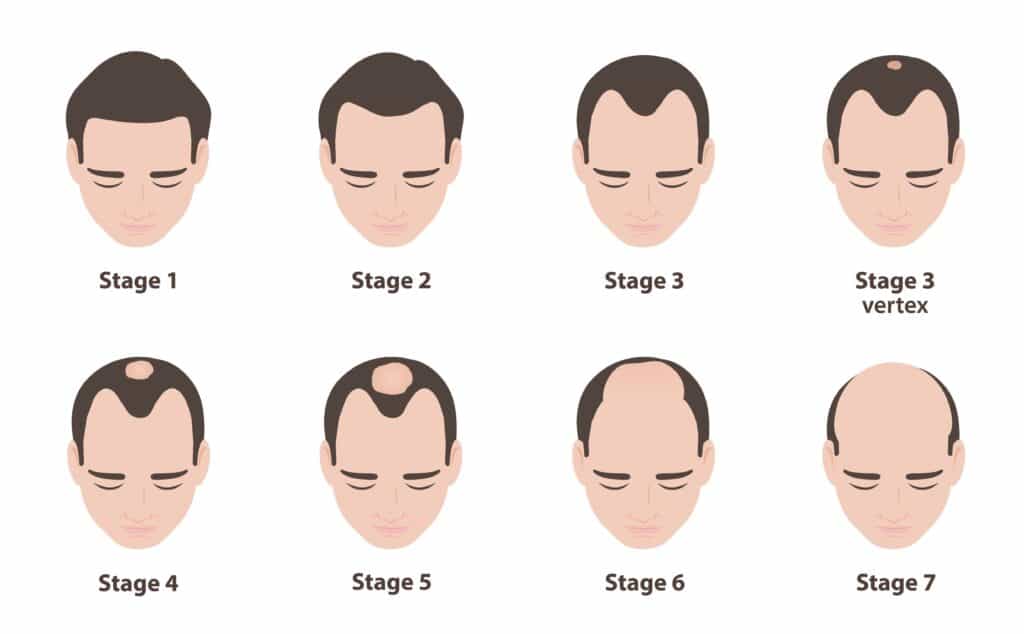
The Hamilton Norwood Scale begins with stage 1, where the hairline remains untouched, and moves up to stage 7, where only the hair remaining lies around the sides and back of the head.
This matters because male pattern baldness doesn’t follow a single formula. Some men lose density first at the frontal area, others at the crown, and some experience both simultaneously.
So, doctors observe the balding areas and identify not just the present state, but the likely future progression too.
At Cosmedica, this scale helps determine:
- Your stage and areas of hair loss.
- How much donor hair you still have.
- Whether a hair transplant is the most suitable solution or if medical therapy might slow progression.
What Are the 7 Stages of the Norwood Hamilton Scale?
Stage 1
Norwood stage 1 shows no significant hair loss as the hairline appears full and even. There’s no visible recession, and the top of the scalp shows normal density.
Stage 2
Early Hairline Recession
Early hairline recession starts with Norwood stage 2, especially around the temples. However, this is a normal process of aging. There’s usually no further hair loss at the crown.
This stage often reflects a maturing hairline rather than true male pattern baldness, but it marks the beginning of change.
Stage 3
Norwood 3 is the first stage where deep temporal recession appears. It forms the classic M-shaped hairline when there is hair loss around both temples.
The frontal area begins to thin more noticeably, especially under bright light.
Stage 4
In this stage, hair loss now reaches the top of the head (the vertex). A band of hair still separates the front and crown, but it’s starting to narrow.
This is often the stage when men begin seeking professional evaluation.
Stage 5
The frontal and vertex bald regions move closer together. The hair remaining on the sides and back starts to take on the familiar horseshoe shape.
With a Norwood 5 hair transplant, implanting new hair follicles into the crown or the hairline is possible.
Stage 6
At this point, the balding areas across the top of the scalp have joined. Only a thin band of hair remains on the sides of the head, and coverage on top is minimal.
This stage requires strategic graft placement to achieve a natural result.
Stage 7
The most advanced stage of hair loss on the Norwood Scale. Only a narrow rim of hair remaining on the sides and back remains.
For many, this is where advanced hair restoration planning becomes essential.
How Does the Norwood Scale Affect Hair Transplant Planning?
The Norwood Hamilton stage isn’t just for classification. It serves as the foundation of every successful hair transplant. It helps the doctor estimate:
- How many grafts are realistically available.
- The strength and density of your donor area.
- Which technique will deliver the most natural result.
For instance:
Stages Two to Three
Great candidates for FUE (Follicular Unit Extraction) to fill in temples or the frontal hairline.
Stages Four to Five
Often benefit from a Micro Sapphire DHI procedure to increase density while preserving natural angles.
Stages Six to Seven
Focuses on creating realistic coverage and a flattering frontal area frame using donor hair from the sides.
You can explore real examples of each stage in our hair transplant Turkey before and after gallery.
How Do You Know Your Norwood Hamilton Stage?
A specialist can identify your stage of hair loss and offer targeted solutions before it progresses further. Some early signs include:
- A “V” or “M” shaped recession of the hairline.
- Thinning at the crown or top of the head.
- A visible separation between thicker and thinner regions.
You can also compare your hair pattern with diagrams available on reliable sources such as the American Hair Loss Association or Healthline’s Norwood Scale guide.
Why Is the Norwood Hamilton Scale Important for Patients?
Many people notice thinning hair or a receding hairline but aren’t sure what it means. The Norwood Scale takes that uncertainty away. With it, both patient and doctor can:
- Track progression accurately.
- Measure changes over time.
- Choose the right balance between medical management and surgical options.
When you identify your stage of hair loss, your Dr. can tailor a plan that aligns with your current pattern while planning for possible future balding areas.
Which Hair Transplant Methods Fit Each Stage?
At Cosmedica Clinic, Dr. Levent Acar uses two modern, minimally invasive techniques:
- FUE (Follicular Unit Extraction): Each follicular unit is extracted individually with a micro-punch and implanted in the target area with precision.
- Micro Sapphire DHI: A next-generation method that combines the precision of DHI with the smooth incisions of sapphire blades.
Why patients prefer Micro Sapphire DHI:
- Higher graft survival rate.
- Faster healing and less scarring.
- More natural-looking density.
The sapphire blade allows for micro-incisions that heal faster and look cleaner. You can learn more about it on our Micro Sapphire DHI page.
Can a Hair Transplant Restore Every Norwood Stage?
Not every case of male pattern baldness is the same, but many can be improved dramatically. The key lies in the hair remaining on the sides of the head, which serves as the donor source.
Even patients at advanced stages, can often achieve a meaningful transformation. Dr. Levent Acar specializes in designing restorations that complement each person’s face rather than chasing unrealistic density.
Results depend on donor supply, technique, and long-term care, but the right plan can redefine confidence entirely. You can explore pricing and package options in our transparent guide on Turkey hair transplant cost.