5,600 Graft DHI Hair Transplant Results: Mathias' Case Study

This case study details the hair transplant journey of a patient who received 5,600 grafts in Istanbul, targeting both the hairline and the mid-scalp.

Supervised by Dr. Levent Acar using the DHI (Direct Hair Implantation) technique, the procedure focused on restoring seamless, natural hair density across the entire scalp.

Before and after results of a 5600 grafts Micro Sapphire hair transplant at Cosmedica Clinic
Patient Mathias M., age 29, France
Technique Micro Sapphire DHI
Graft Count 5,600 grafts
Treated Areas Hairline and mid-scalp
Outcome Typically, progressive density along the hairline and mid-scalp

Case at a Glance

Mathias M., 29, underwent a 5,600-graft Micro Sapphire DHI hair transplant in Turkey at Cosmedica to restore his hairline and mid-scalp. This case study documents his full results timeline, from procedure day through 18 months, including his treatment plan, recovery milestones, and cost breakdown.

Mathias traveled from France to Istanbul for the procedure, which took place on March 11, 2025, under the supervision of Dr. Levent Acar. This case illustrates a targeted approach for two adjacent areas, the hairline and mid-scalp, a common pattern for patients experiencing progressive hair loss that has not yet extended to the crown.

Patient Profile

At age 29, Mathias presented with hair loss concentrated primarily along his hairline and mid-scalp, without significant recession at the crown.

This pattern, often linked to genetic predisposition (androgenetic alopecia, also known as male pattern baldness), requires a thorough evaluation of the donor area and available hair density before creating a customized restoration plan.

As with any patient considering a transplant, future hair loss progression is an important topic to discuss directly with a physician, since patterns vary from person to person, and this case does not address crown-area coverage.

Photo of a man before a 5600 Micro Sapphire DHI hair transplant in Turkey at Cosmedica Clinic

Treatment Strategy: Why DHI and Why 5,600 Grafts

Following an initial remote hair assessment and an in-person consultation upon his arrival in Istanbul, the medical team recommended a 5,600-graft Micro Sapphire DHI transplant split between the hairline and mid-scalp. Choosing the DHI technique (Direct Hair Implantation) allows for precise control over the angle, direction, and depth of placement, which is particularly effective for rebuilding a natural-looking hairline while ensuring a smooth transition into the mid-scalp area.

Dr. Levent Acar notes that combined hairline and mid-scalp cases require careful graft distribution to preserve donor density for any future treatment needs, since the donor area is a finite resource that must be managed with the patient’s long-term hair loss pattern in mind.

Montage photo montrant un homme juste après une greffe de cheveux de 5600 greffons en Turquie chez Cosmedica Clinic.
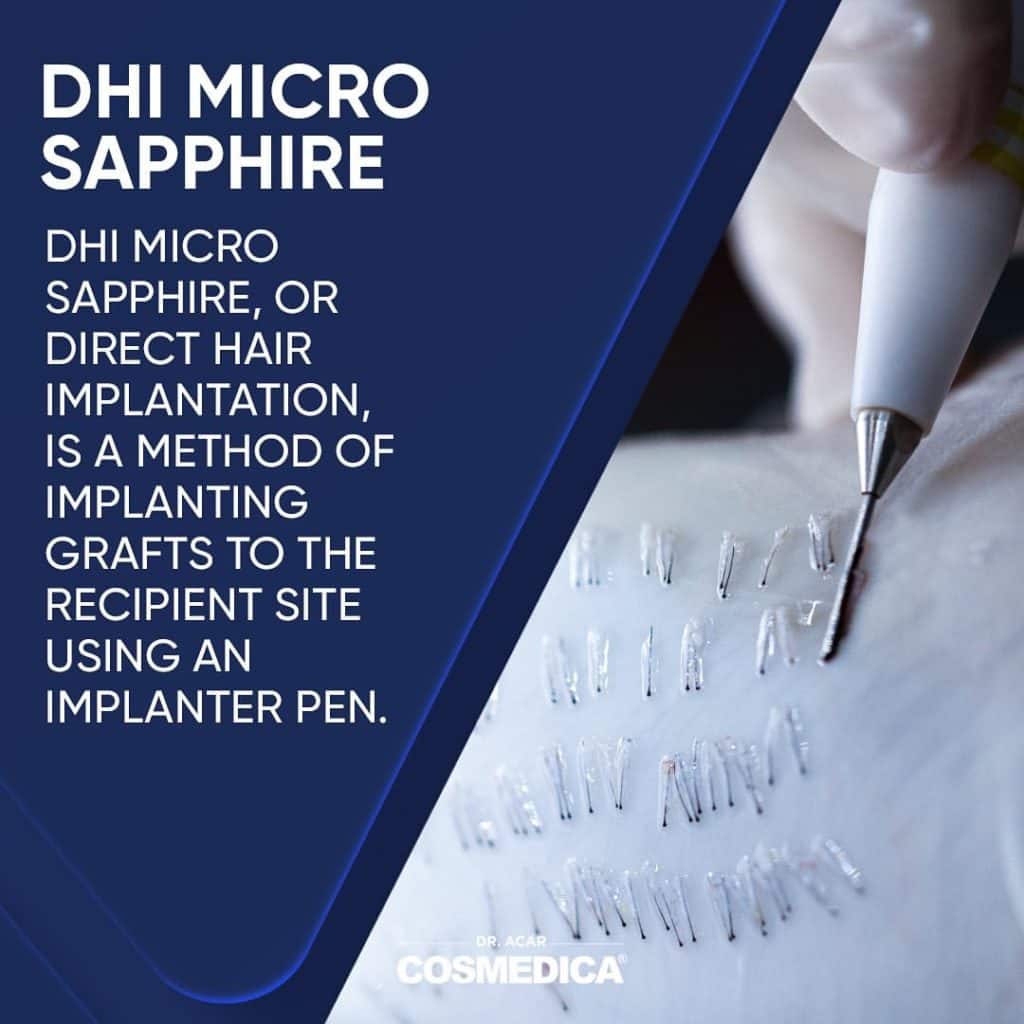
DHI Implanter pen and hair grafts

Procedure Details

The procedure was completed on March 11, 2025, in a single day under local anesthesia. After harvesting grafts from the donor site, typically the back and sides of the head, where hair follicles are naturally resistant to thinning, the grafts were implanted directly using an implanter pen without requiring separate prior channel incisions.

This approach minimizes the time grafts spend outside the body and reduces tissue trauma, though final results always depend on individual patient factors.

Patient Experience in Istanbul

Like most international patients at Cosmedica, Mathias received complete English-language guidance throughout his stay: airport pickup, clinic transfers, translation services when needed, and personalized pre- and post-operative support.

This turnkey service simplifies the journey for patients visiting from abroad so they can focus on recovery rather than travel logistics.

Timeline & Results: Key Stages After a 5,600-Graft DHI Hair Transplant

Before the Hair Transplant, Initial Condition

Prior to surgery, Mathias showed visible thinning along his hairline and mid-scalp, while maintaining good native density at the crown.

Month 1 Post-Op: Healing Phase and Shock Loss

During the first month, the scalp heals. Temporary shedding of the newly implanted hair, known as shock loss, is very common. While this stage can feel concerning, it is a normal part of the growth process, as the underlying hair follicles remain healthy beneath the skin.

Month 3 Post-Op: Early Signs of Growth

Around month three, fine new hairs begin to emerge in the treated areas. Growth rates vary significantly among patients, so early results are not indicative of the final outcome.

Month 6: Visible Density in the Hairline and Mid-Scalp

By month six, noticeable density takes shape, particularly along the hairline, with progressive improvement in the mid-scalp area. Hair thickness and texture continue to mature over the following months.

Months 12 to 18: Final DHI Transplant Results (Before & After)

The full result of a DHI transplant is typically evaluated between 12 and 18 months post-op, once hair density and texture have stabilized. As with any medical procedure, results vary based on individual factors, including donor site quality, post-op care, and genetics.

Request a free consultation

Please contact us for your questions about hair transplantation in Turkey or to receive a free assessment for your hair loss. Our team of highly trained experts will provide you with the necessary information.

Get an analysis and consultation with one of our hair transplant specialists.

FR Web Site - Form

  • This field is for validation purposes and should be left unchanged.
  • This field is hidden when viewing the form

Key Takeaways from Mathias' Case

Mathias’ experience highlights several useful principles for anyone considering a high-volume hair transplant:

  • The hairline and mid-scalp respond well to regrowth in many cases: These areas typically benefit from strong blood circulation, which can support graft maturation between 12 and 18 months.
  • Donor area preservation is critical: Harvesting 5,600 grafts requires high surgical skill to avoid over-harvesting this finite resource.
  • The DHI technique is well suited to high-volume cases: It allows direct, precise implantation without requiring separate channel incisions, minimizing tissue trauma.
  • Aftercare matters: Using supportive treatments such as specialized shampoo, Minoxidil, or hair vitamins, as recommended by a physician, plays a role in supporting long-term hair growth.

In Mathias’ case, 5,600 grafts were sufficient to restore his hairline and mid-scalp. For those wondering how many grafts may be needed for a similar pattern of advanced hair loss, this case shows that over 5,000 grafts can be required when treating both the hairline and mid-scalp simultaneously, though needs vary by individual. The stage of hair loss, often assessed using the Norwood-Hamilton Scale, is a useful starting point for evaluating your own needs prior to a consultation.

Photo of a man one year after a 5600 Micro Sapphire DHI hair transplant in Turkey at Cosmedica Clinic

Are 5,600 Grafts Enough for Full Coverage?

In Mathias’ case, 5,600 grafts were enough to cover his hairline and mid-scalp, but this figure does not apply universally, and the right number for any individual depends on several factors:

Key factors:

  1. The size of the treatment area: Restoring the hairline and mid-scalp requires different graft density than covering the entire scalp from front to crown.
  2. Donor site quality: The total number of harvestable grafts depends on the patient’s hair density and scalp elasticity.
  3. The patient’s aesthetic goals: Some patients prioritize a dense hairline, while others prefer even coverage across a broader area.
  4. Surgeon experience: A skilled surgeon balances graft placement to maximize visual density, though exact results vary per individual and are never guaranteed.

In Mathias’s case, 5,600 grafts made it possible to treat both the hairline and the mid-scalp in a single session. Only a personalized consultation with Dr. Levent Acar can determine whether this volume is right for your specific hair profile.

FAQ: 5,600 Graft DHI Hair Transplant

Duration varies by case, but a high-volume procedure of this size is typically completed in a single day.

Yes. Temporary hair shedding during the first few weeks is a normal part of the healing process and does not mean the transplant failed.

Shock loss is the temporary shedding of newly implanted or existing hair that can occur in the first few weeks after a transplant. It typically resolves within one to three months as the hair follicles enter a new growth cycle.

Final results are usually evaluated between 12 and 18 months post-op, once density and texture have fully matured.

Yes. DHI provides precise control over graft angle and direction, which helps create a natural-looking transition across multiple treated zones.

Not necessarily. In Mathias’ case, the 5,600 grafts were allocated specifically to the hairline and mid-scalp, not the crown. Treating three zones, hairline, mid-scalp, and crown, typically requires a higher graft count or a staged approach over multiple sessions, depending on donor supply.

Prices vary by clinic and graft volume, but costs in Istanbul are generally significantly lower than in Western Europe or the US. A free hair analysis can provide a personalized quote.

No. International patients receive complete English-language assistance throughout their stay, from airport transfers to post-operative follow-up.

Most patients addressing both the hairline and mid-scalp require between 4,500 and 6,000 grafts, depending on donor density and the degree of existing loss. A free hair analysis is the most reliable way to get a graft estimate specific to your scalp.

Both techniques can address the hairline and mid-scalp effectively. DHI is often preferred for hairline precision and angle control, while FUE may allow higher graft volumes in a single session. The right choice depends on individual scalp characteristics, best assessed during a personalized consultation.