



Medically reviewed by Dr. Levent Acar, MD
Founder & Lead Hair Transplant Surgeon
Updated on: July 30, 2026
It’s not an easy process to accept for most men. But yes, it finally happened. Your temples are moving back; your frontline now forms an obvious M-shape, which you can no longer hide. That’s it, you’ve reached what hair specialists call the Norwood Scale 3. Stage 2 could still be explained away, but stage 3 cannot. This is the stage where male pattern balding is officially classified as balding, and where most men seriously start looking at their options.
What is the Norwood Hamilton Scale?
The Hamilton-Norwood Scale is the standard system doctors use to classify male pattern hair loss. Dr. James Hamilton developed the original framework in the 1950s, and Dr. O’Tar Norwood later updated it in 1975.
The scale runs from Norwood 1 to Norwood 7 and tracks the progression of male pattern baldness. Stage 1 shows little to no visible hair loss, while Stage 7 represents advanced baldness with only a narrow band of hair remaining around the sides and back of the scalp.
Norwood identified Stage 3 as the minimum point for true hair loss. In other words, the earlier stages usually reflect a maturing or shifting hairline rather than established baldness. Stage 3 is where the pattern becomes clearer, especially when recession at the temples or thinning at the crown becomes more pronounced.
According to the American Hair Loss Association, around two-thirds of men experience noticeable hair loss by age 35. Many first pass through Norwood Stage 2, often without recognizing it as an early sign of a changing hairline.
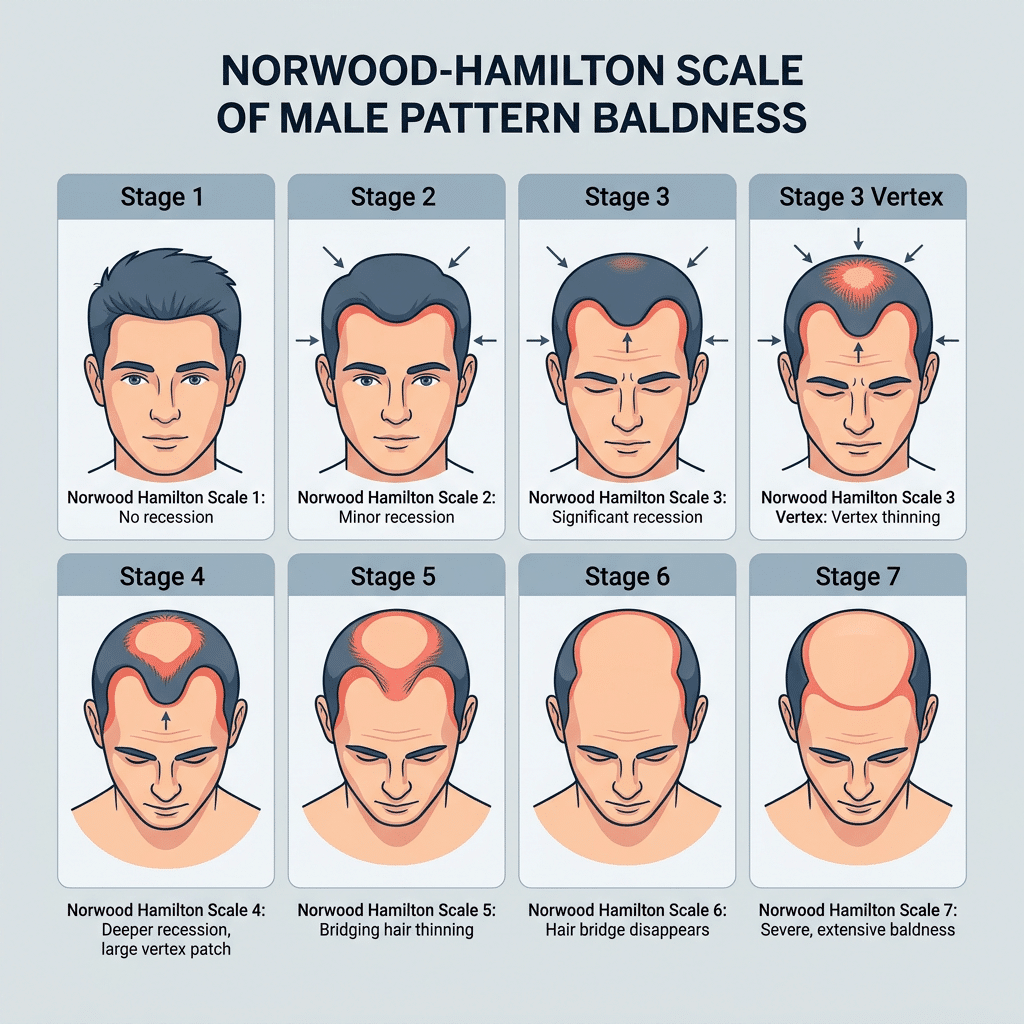
What Does a Norwood 3 Hairline Look Like?
Mainly, it looks like a deep temple recession. The M-shape is clearly defined from the front, not just from a top-down photo. The hairline has pulled back farther than a mature hairline would, and the dips at the temples are wide enough to be noticeable in conversation.
Two patterns show up at this stage:
- Classic Norwood 3: Temple recession only. The crown is untouched.
- Norwood 3 Vertex: Temple recession plus early thinning at the crown. A small bald patch may already be forming at the back of the top.
If you are not sure which one applies to you, take a photo from directly above. Crown thinning in a 3 Vertex is easy to spot from that angle. It matters because a surgeon planning a transplant needs to account for both zones, not just the front.
How Long Does It Take to Progress from Norwood 2 to Norwood 3?
Depends entirely on the individual. Some men go from stage 2 to Norwood Scale 3 in under a year. Others take the better part of a decade. Some never get there at all.
Family history is the biggest factor. High DHT sensitivity speeds things up. No treatment speeds things up further. According to a review published on the NIH National Library of Medicine, androgenetic alopecia is the primary driver of progression across the stages of male pattern baldness, with genetics as the main variable.
There is no test that tells you how fast your hair loss will progress. What the research does show is that stage 3 rarely holds steady on its own without some form of intervention.
How Do You Treat Hair Loss at Norwood Stage 3?
Both medical and surgical options are relevant here. So let us look at what is actually available.
- Finasteride (1mg daily) blocks DHT, the hormone behind male pattern hair loss and follicle miniaturization. A 2019 study in the Journal of Dermatology found 85.7% of patients showed measurable improvement after five years of use.
- Minoxidil (topical, twice daily) works on blood flow and extends the growth phase of existing follicles. Does not touch DHT. Most doctors pair it with finasteride rather than use it alone.
- PRP therapy uses growth factors from the patient’s own blood, injected into the scalp. It supports follicle health. Does not reverse the receding hairline on its own, but works well alongside other treatments.
At stage 3, many patients are already thinking about surgery. The donor area is still healthy. The pattern is defined enough to plan around. To get a sense of what is achievable, take a look at hair transplant in Turkey outcomes from Cosmedica.
Jacob Kolosov, a patient of Dr. Acar at Cosmedica, remembered his first consultation: “Dr. Acar is absolutely amazing. He makes you feel confident in the process. All my questions were answered.”
How Many Grafts Are Needed for Norwood 3 Hair Loss?
Most patients need between 1,500 and 2,500 grafts. Where you land in that range depends on how deep the temple recession is and whether the crown needs attention too.
A rough guide:
- Temples only: 1,500 to 2,000 grafts
- Temples and early crown: 2,000 to 2,500, sometimes more
The number that does not show up in the quote but should be part of every conversation is how many grafts you keep in reserve. Because hair loss will continue throughout your life. Using everything available now to fix today’s pattern can leave nothing for stage 4 or 5 if things progress. Every reputable surgeon factors future loss into the plan.
The Turkey hair transplant cost page at Cosmedica breaks down pricing by graft count, so you can understand what different options look like financially.

What Do Norwood 3 Hair Transplant Results Look Like?
At stage 3, the treatment zone remains focused, and the donor area remains healthy. The surgeon is restoring a hairline, not rebuilding one from scratch. That difference shows in the results.
At Cosmedica Clinic, Dr. Levent Acar performs stage 3 procedures using either the Micro Sapphire DHI technique or the FUE Sapphire method, depending on the individual case. Both use a sapphire blade for smaller, more precise incisions than conventional techniques. The DHI implanter pen adds an additional layer of control over graft angle and direction. At the hairline, that precision matters. Get it wrong, and the result looks artificial even at full density.
New growth starts appearing from months 3 to 4. Most patients see a clear difference at 6 months. Full assessment at 12 months.
Keiran Lee, British actor and Cosmedica patient: “I felt like a 25-year-old Keiran again. It was unbelievable that I could look in the camera again and see my hair, flowing locks. It just looked perfect.”
Real patient outcomes across multiple stages are available on Cosmedica’s hair transplant Turkey before and after page.
FAQ: Norwood Scale 3 Hair Loss
Is Norwood 3 actually balding? Yes, by definition. Norwood placed stage 3 as the minimum threshold for true balding on the scale. Earlier stages are hairline shifts. Stage 3 is hair loss.
Can medication reverse Norwood 3? Not the recession itself. Finasteride and minoxidil can help prevent further hair loss and sometimes improve density in thinning areas, but they do not regrow a receded hairline. Surgery does that.
What is Norwood 3 Vertex? It is the stage 3 version in which crown thinning appears alongside a receding hairline. Two zones instead of one. Changes the graft count and the surgical plan. Worth identifying before committing to a procedure.
How long does the procedure take? Six to eight hours for most stage 3 cases. Longer if the crown is also being addressed.
Will the transplanted hair eventually fall out? The transplanted follicles come from the donor area and are genetically resistant to DHT. A hair transplant is permanent and hair keep growing permanently. The native hair around them is not protected, which is why ongoing post-surgery medication still matters.
Is now a good time for a hair transplant at Norwood 3? Most surgeons would say yes. The donor area is healthy, the treatment zone is manageable, and results at this stage tend to be among the most natural.
Am I too young for a Norwood 3 hair transplant? Age is a factor, but not a hard rule. The main concern with younger patients is that hair loss has not yet fully established its pattern. Operating too early can mean the transplant looks out of place in five years as the surrounding hair continues to recede. Most surgeons want to see a stable pattern before proceeding, and will usually recommend medication first to slow progression. A thorough scalp analysis at consultation gives a clearer picture of where things are heading.