


What if the hair you lost years ago isn’t gone, but only sleeping?
The new PP405 hair loss treatment is getting a lot of attention from doctors and researchers. For a long time, people believed that once a follicle stopped growing hair, it was gone forever. However, new studies suggest that many may simply be inactive or resting, rather than destroyed.
PP405 is designed to help wake them up. This new approach is part of a growing field called regenerative medicine, which focuses on helping the body repair itself. In this article, we examine how PP405 works, the results of its initial trials, its comparison to other hair loss treatments, and whether waiting for it could be worthwhile.
What is PP405?
PP405 is a topical small molecule developed by the company Pelage Pharmaceuticals within the field of regenerative medicine. It is designed to reactivate hair follicle stem cells that have entered a quiescent state. This compound is non-hormonal and is aimed at both men and women with pattern hair loss, which is known as androgenetic alopecia.
What are the Key scientific features?
Let’s take a look at the key features of PP405:
- PP405 acts as an inhibitor of the mitochondrial pyruvate carrier (MPC) in follicle cells.
- As an inhibitor, it increases lactate dehydrogenase (LDH) activity and prompts dormant stem cells to re-enter the hair growth phase.
- The company and its advisory board emphasize that they were diverse in their recruitment of men and women, as well as in multiple skin and hair types, and objective biomarker endpoints.
Pelage’s team describes the goal as simple yet transformative: use small-molecule precision to harness the body’s own regenerative capacity. The involvement of experts such as the vice chair of clinical trials and innovation at Brigham and Women’s Hospital highlights how seriously the medical community views this innovation.
How does PP405 work?
The biological cycle of hair involves phases: growth (anagen), regression (catagen), and rest (telogen). In androgenetic alopecia-
- The anagen phase shortens,
- Follicles miniaturise,
- Hair density declines, and the visible hair vanishes.
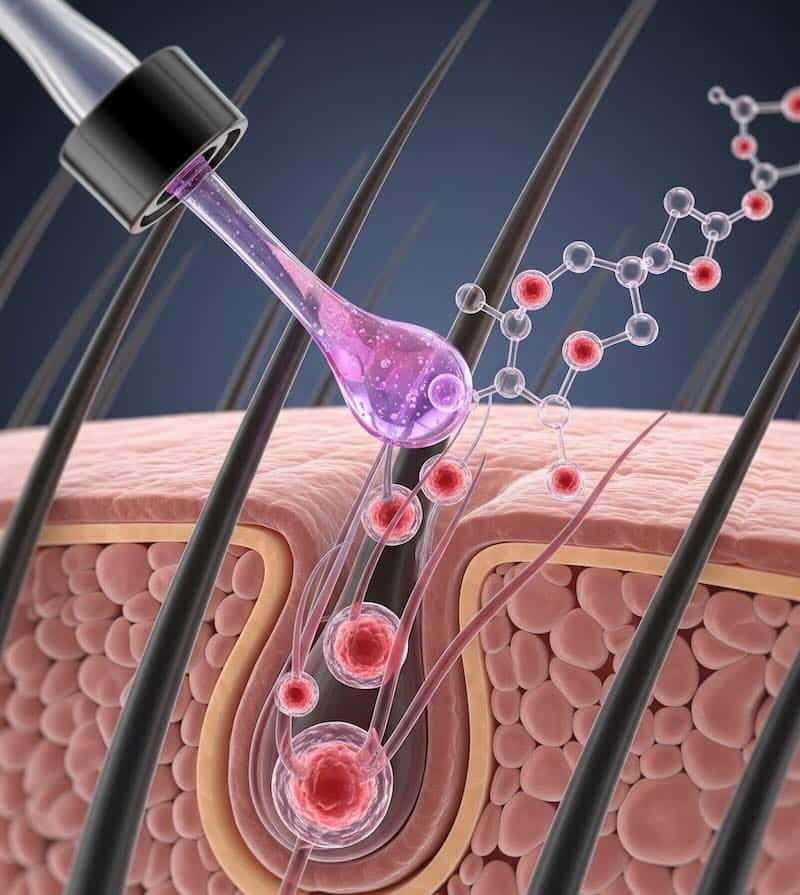
The new paradigm with PP405 is that many of those follicles are not dead, but asleep. The therapy targets the metabolic switch in stem cells that control whether a follicle is active or dormant. Here is a simplified breakdown of the mechanism:
- PP405 inhibits the mitochondrial pyruvate carrier, thereby shifting the cell’s metabolism from oxidative phosphorylation toward glycolysis and increasing LDH activity.
- Increased lactate and glycolytic flux signal the stem cells to divide and activate the follicle growth cycle.
- The result is entry into or prolongation of the anagen phase, thicker (“visible hair”) shafts, and improved hair density.
Is PP405 available? What symptoms does it treat?
No: PP405 is currently not commercially available. It remains in the clinical development pipeline (Phase 2a clinical trial) for androgenetic alopecia. The treatment is designed for:
- Men and women with thinning hair due to androgenetic alopecia.
- Areas where follicles remain but have become dormant rather than completely destroyed.
- Likely not effective in major bald zones where follicles are absent or scarred beyond repair.
Does PP405 work compared to existing treatments?
The early clinical trial data for PP405 show promise, although they are still preliminary. Here are some headline findings:
- In the Phase 2a trial involving 78 men and women aged 18-55, PP405 met its primary safety endpoint, as no systemic absorption was detected.
- Approximately 31% of men with a higher degree of hair loss treated with PP405 experienced an over 20% increase in hair density at the 8-week follow-up, compared to 0% in the placebo group.
- The trial design emphasised measurable biological activity. There was increased Ki67 (a marker of cell proliferation) in biopsied follicles within days.
By contrast, standard hair loss treatments, such as topical minoxidil and oral finasteride, often take 3-6 months to show visual improvement. Furthermore, patients frequently do not respond to these treatments. Thus, the early action of the PP405 hair loss treatment is noteworthy.
However, we should emphasise scientific caution. Long-term outcomes, durability of effect, head-to-head comparisons, and long-term impact in very advanced hair loss are not yet known. As a result, PP405 cannot yet replace existing therapies or a hair transplant.
Dormant vs. dead hair follicles: Why does it matter?
One of the most important scientific insights when discussing PP405 is the distinction between dormant and dead follicles. It underpins both the promise and limitations of the treatment.
- Dormant follicles: The hair follicle structure and stem-cell reservoir are still present, but the follicle is locked in telogen or miniaturised state. These are the primary targets for PP405.
- Dead follicles: Follicles have been lost, replaced by scar or fat; no viable germinative cells remain. In those zones, only follicle replacement surgeries (e.g., FUE or grafting) are viable.

Why hair transplants still lead the way
If a region is bald because follicles are absent or destroyed, medical therapies alone will not restore hair-forming units. That is why surgical restoration remains the gold standard in some instances.
At Cosmedica Clinic in Istanbul, patients are offered modern techniques, including Micro Sapphire DHI, a refined form of FUE. The Micro Sapphire DHI procedure involves:
- Extraction of individual follicular units from the donor zone using a micro-punch.
- Creation of insertion canals with micro-sapphire blades (smaller incisions, reduced trauma).
- Implantation of follicles via a DHI pen, which protects grafts and enables precise angulation.
These steps, taken together, represent why hair transplant Turkey continues to set international standards for modern restoration.
Such techniques also show how surgical and regenerative approaches can work side by side. Where innovative agents such as PP405 may re-activate dormant follicles, a transplant can restore areas where follicles are permanently lost.
To see visual examples of real-world outcomes, visit hair transplant Turkey before and after.
For detailed package and procedure information, you can also review Turkey hair transplant cost options provided by Cosmedica Clinic.
Should you wait for PP405?
The development of the pp405 hair loss treatment signals a shift in how researchers view hair loss: not simply as a hormonal imbalance or cosmetic issue, but as a regenerative biology challenge. So, should you wait for PP405? Let’s take a look:
- If you are in early stages of hair thinning, you may still have many dormant follicles. Currently, with approved medical therapy, lifestyle measures, and consultation, you may preserve more follicles.
- If you already have significant bald patches with little native hair, relying solely on a future therapy like PP405 may delay effective treatment and result in further loss of transplantable donor hairs.
Ultimately, waiting only makes sense if you understand the risk of progression and are comfortable with the uncertainty of still-investigational therapy.